The "Cowboy Mafia" Delusion: Inside Nathan Pinkney’s Sprawling, Slanderous Shasta County Rant
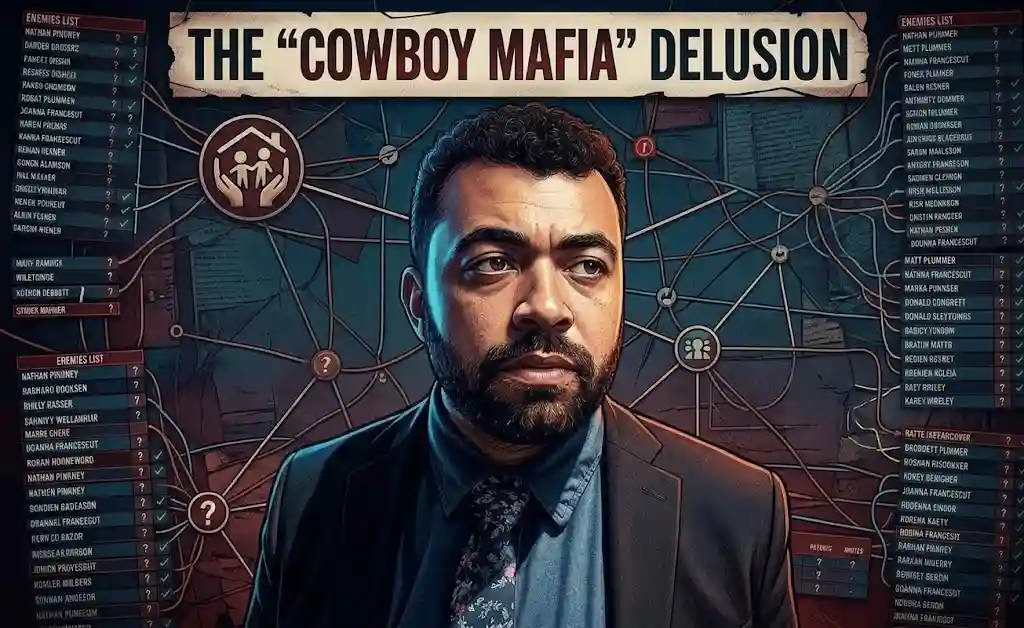
Local progressive satirist Nathan Pinkney broadcast an enemies list targeting over 50 Shasta County residents, invoking federal racketeering charges and reviving debunked scandals while glossing over personal legal troubles.
REDDING, Calif. — In local politics, there is a distinct boundary between holding public officials accountable and broadcasting an unhinged, defamatory monologue across social media. Local progressive satirist and self-described "Dirtbag Left" activist Nathan Pinkney—known online by monikers such as "Nathan Blaze" and the creator behind pages like Redding Be Like—erased that line entirely in a recent video broadcast on Facebook.
Pacing in front of a camera, Pinkney claimed that his "reputation" and supposed "eidetic memory" grant him unique authority before rattling off an indiscriminate enemies list of more than 50 local residents, elected officials, attorneys, judges, law enforcement officers, and private citizens. Claiming that Shasta County is governed by an illicit criminal syndicate he branded the "Cowboy Mafia," Pinkney called for federal law enforcement to sweep in with Racketeer Influenced and Corrupt Organizations (RICO) Act indictments.
Pinkney insisted that his public enemies list is merely an "avoid list" of "dangerous" people rather than a "hit list." Yet his performance was nothing short of an open digital broadside: a scattershot compilation of genuine historical grievances mixed with debunked conspiracy theories, personal vendettas against police officers, and accusations of serious felonies against private citizens.
The RICO Fantasy: Why Local Politics Is Not the "Cowboy Mafia"
The centerpiece of Pinkney’s broadcast is his insistence that Shasta County’s conservative leaders constitute an organized criminal syndicate ripe for a federal takedown modeled after Rudy Giuliani's prosecution of the New York mob. Invoking the term "Cowboy Mafia," Pinkney listed everyone from former and current county supervisors to local ranchers, business owners, and elections commissioners, claiming they belong in a single federal indictment.
In federal jurisprudence, however, the "Cowboy Mafia" is not a loose metaphor for contentious county politics; it was an actual criminal syndicate convicted in 1982 for smuggling more than 100 tons of Colombian marijuana through the Gulf Coast. Under 18 U.S.C. §§ 1961–1968, establishing a federal civil or criminal RICO claim requires strict statutory proof:
An ongoing, distinct enterprise with an ascertainable organizational structure (Boyle v. United States);
Direct managerial control over the illicit operation (Reves v. Ernst & Young); and
A continuous pattern of specifically enumerated state or federal felonies—such as murder, kidnapping, bribery, extortion, or bank fraud.
Federal courts, particularly the Ninth Circuit Court of Appeals, have repeatedly dismissed attempts to label political factions, aggressive board voting blocs, and partisan advocacy as racketeering syndicates. In rulings such as Loomer v. Meta Platforms, Inc., the court affirmed that shared political ideologies, joint lobbying, and parallel voting conduct fail to constitute an association-in-fact enterprise. Furthermore, the Ninth Circuit held in Lancaster Community Hospital v. Antelope Valley Hospital District that public governmental entities cannot form the criminal intent necessary to commit RICO predicate crimes.
By broadcasting false accusations of organized felony racketeering to the public, Pinkney ventures into perilous legal territory under California tort law. Under California Civil Code §§ 45a and 46, falsely accusing individuals of felony conduct or attacking professionals, attorneys, and judges in their official trade constitutes defamation per se, where general reputational damages are presumed without requiring proof of out-of-pocket financial injury.
While Pinkney claimed he was creating a record for "law enforcement agencies," California courts have firmly established that extrajudicial rants on social media do not enjoy litigation immunity. In landmark rulings like Rothman v. Jackson and GetFugu, Inc. v. Patton Boggs LLP, California appellate courts ruled that posting accusations of pending investigations to online audiences falls entirely outside the statutory litigation privilege of Civil Code § 47(b).
Weaponizing the Children’s Legacy Center: A Debunked Smear
Among the most egregious accusations in Pinkney’s video is his claim that former Redding Mayor and supervisorial candidate Erin Resner, alongside former Shasta County District Attorney Stephanie Bridgett, was involved in "missing money" from the Children's Legacy Center (CLC), where Resner served as board treasurer and Bridgett as secretary.
Pinkney’s insinuation parrots a political talking point that has been thoroughly investigated and formally debunked by the State of California:
The $7 Million Settlement Allocation: During her tenure, District Attorney Bridgett directed $7 million from a $50 million criminal settlement with Pacific Gas & Electric over the deadly 2020 Zogg Fire to the Children’s Legacy Center to construct juvenile trauma facilities and child abuse intervention programs.
Complete State Exoneration: Following a comprehensive review, the California Department of Justice issued an official letter on January 29, 2024, fully clearing DA Stephanie Bridgett of any criminal conflict of interest or fiscal wrongdoing, confirming that the settlement allocation was entirely within lawful prosecutorial discretion.
State Pilot Grant Realities: While the California Department of Social Services did terminate a separate regional foster care pilot grant with CLC, administrative reviews by the Legislative Analyst’s Office confirmed the cancellation was driven by complex state licensing hurdles and foster care regulatory shifts under AB 2496, not financial embezzlement or missing funds. Inquiries by the Shasta County Grand Jury produced no adverse findings or criminal indictments against the center, Bridgett, or Resner.
By repeating claims of "missing money" against Resner and the Children's Legacy Center, Pinkney ignored official state findings, recycling discredited political attacks while presenting them as insider knowledge.
The Personal Vendetta Behind the Badge: Deflecting from a Tragic DUI
Pinkney’s video takes an aggressive turn when targeting the Redding Police Department, singling out Officer Alexandra Dahnke (whom he derisively called "Officer Alex Donkey") and claiming local police hid body-camera footage to protect bad actors.
Public court records from Shasta County Superior Court provide the real context behind Pinkney’s hostility toward Officer Dahnke and the Redding Police Department:
On the evening of November 17, 2023, Pinkney’s wife, local defense attorney Lisa Marie Jensen, was riding an electric motorized scooter along a downtown Redding pedestrian sidewalk after consuming alcohol. Jensen struck an elderly pedestrian, Calvin Johanessen, from behind. The collision caused catastrophic injuries: Johanessen suffered extensive hemorrhaging and a shattered ankle that required multiple reconstructive surgeries.
Officer Dahnke served as a primary investigating officer at the scene. Field sobriety evaluations and chemical testing confirmed the presence of alcohol. Under California law, operating a motorized scooter on pedestrian sidewalks and driving while impaired are statutory violations; when demonstrable impairment results in serious bodily injury, prosecutors can bring felony DUI charges regardless of whether the driver’s blood alcohol content is above or below 0.08%.
The Shasta County District Attorney’s Office prosecuted Jensen, and she subsequently entered a guilty plea to DUI and reckless driving causing bodily injury. A Superior Court judge sentenced Jensen to 120 days in the Shasta County Jail (with 30 days mandatory execution), five years of formal probation, and a three-year driver’s license suspension, while her conviction was forwarded to the State Bar of California for disciplinary proceedings.
Pinkney attempted to contest the arrest by filing an administrative complaint against Officer Dahnke through an open-source Giglio-Brady registry, claiming officers fabricated evidence and misclassified the scooter's horsepower. However, neither the Redding Police Department nor the District Attorney found any basis for disciplinary action.
Furthermore, Pinkney’s claims that police illegally withheld body-camera footage misrepresent California law. Under California Government Code § 7923.625 (Assembly Bill 748), law enforcement agencies are required to release body-worn camera footage within 45 days only for "critical incidents," specifically peace-officer shootings or officer uses of force causing death or great bodily injury. Because the scooter collision was a civilian crime involving no police use of force, RPD appropriately adhered to Government Code § 7923.600 and California Vehicle Code § 20012, keeping investigative files and accident reports confidential except through formal criminal discovery.
Framing the legitimate, court-affirmed felony prosecution of a repeat alcohol offender who critically injured an elderly man as a police conspiracy demonstrates how Pinkney filters personal grievances into claims of municipal corruption.
"Splashgate," Michael Lake, and the Limits of Voir Dire
One section of Pinkney's rant contains a factual kernel that local residents remember well: his claim regarding Michael Lake and the 2021 criminal trial of Carlos Zapata.
In February 2015, Michael Lake, then 27, shot and killed 45-year-old bicyclist John Scott "Jocko" Souza during a roadside altercation at Hartnell Avenue and Churn Creek Road in Redding. Following an investigation by RPD detectives, the Shasta County District Attorney’s Office determined the shooting was an act of lawful self-defense under California Penal Code §§ 197–198, formally declining to file charges.
Six years later, in late 2021, Zapata stood trial in Shasta County Superior Court for misdemeanor battery and fighting in public after the famous “Splashgate” altercation at Market Street Blade & Barrel, where Zapata threw a drink at Pinkney before associates assaulted Pinkney in the rear alley.
Pinkney’s assertion that Lake served on that jury is factually accurate. Because Lake had never been convicted of a felony, he was legally qualified for jury duty under California Code of Civil Procedure § 203. During jury selection, neither the line prosecutor nor defense counsel struck Lake from the panel. Lake was seated and participated in deliberations—during which Pinkney publicized Lake’s identity online, prompting Lake to later state publicly on that Pinkney had doxxed him while the jury was deliberating.
Yet Pinkney’s leap from this voir dire failure to a vast conspiracy falls flat. Despite Lake’s presence on the jury, the panel did not deliver a summary defense victory: while jurors acquitted Zapata of battery, they convicted Zapata of misdemeanor disturbing the peace by fighting, while convicting his two co-defendants, Christopher Meagher and Elizabeth Bailey, of criminal battery. Judge Jody Burgess sentenced Zapata to 12 months probation, anger management, and a criminal protective stay-away order protecting Pinkney.
From the "Avoid List" to Boardroom Rejection
Pinkney’s video also served as a defense of his controversial "Watch List" or "Avoid List," which leaked from his private, 533-member Facebook group, "The Dirtbag Left." The catalog named dozens of local residents, mocking their appearances, tracking their movements, and labeling them "chuds."
The publication provoked immediate community backlash across local forums such where critics circulated an essay condemning the roster as targeted harassment and cyber-intimidation.
While political compilations generally enjoy broad First Amendment protections under NAACP v. Claiborne Hardware Co., Pinkney’s digital targeting resulted in direct legal consequences. Local defense attorney Shon Northam filed a civil harassment petition against Pinkney in Shasta County Superior Court, and a retired visiting judge issued a one-year restraining order against Pinkney, ordering him to cease harassing Northam under threat of a three-year extension.
Pinkney’s online conduct also derailed his brief attempt to secure formal public office. In June 2024, District 2 Supervisor Tim Garman made the unexpected decision to nominate Pinkney to the Shasta County Elections Commission.
The nomination triggered an immediate clash at the July 2, 2024 Board of Supervisors meeting. While Supervisors Garman and Mary Rickert supported the appointment to bring ideological oversight to an advisory panel pushing unworkable hand-count recommendations, the board majority of Patrick Jones, Chris Kelstrom, and Kevin Crye voted 3–2 to reject Pinkney. Crye explicitly pointed to Pinkney’s profane online videos and controversial public campaigns as evidence of a lack of "moral character."
The Indiscriminate Crossfire
What makes Pinkney’s video particularly destructive is its complete lack of coherence. Alongside his standard political targets, Pinkney threw a wide net across Redding’s civic ecosystem, dragging in individuals who have actively fought against far-right extremism:
He rattled off names of left-leaning figures such as Leonard Moty, Mary Rickert, and Joe Chimenti, who were in favor of COVID-19 lockdowns at immense personal cost due to lack of local support—culminating in Moty’s recall in 2022.
He attacked county legal counsel Joseph Larmour, who has repeatedly warned the board against illegal voting ordinances and advised against preempted charter amendments.
He named Tim Garman, the very supervisor who broke with the hardline majority and nominated Pinkney to the Elections Commission.
He threw in figures connected to Bethel Church like Kris Vallotton, ignoring the nuanced reporting by outlets like CalMatters and SFGATE.
Furthermore, Pinkney’s claims that Shasta County’s institutions are permanently trapped in some kind of right-wing criminal grip ignore how local democracy has operated over the past two years:
Voters rejected former Board Chair Patrick Jones in March 2024, electing left-leaning Matt Plummer with nearly 60% of the vote.
Left-leaning law enforcement veteran Allen Long won District 2 outright, replacing Garman and defeating conservative candidate Laura Hobbs.
Voters narrowly backed contractor Corkey Harmon over Mary Rickert in District 3, breaking the reliable populist voting bloc.
When appointed conservative Registrar Clint Curtis was up for election, Shasta County voters decisively routed him in June 2026, electing left-leaning Joanna Francescut with 58% of the vote.
Conclusion: Accountability vs. Digital Vigilantism
Nathan Pinkney’s latest video is a cautionary case study in modern digital activism. In a county that has faced profound political divisions, genuine accountability requires factual discipline, ethical responsibility, and strict adherence to the public record.
By publishing sweeping enemy directories, accusing political adversaries of felony racketeering without evidence, reviving debunked non-profit scandals, and treating a family member's court-affirmed DUI conviction as a police conspiracy, Pinkney does not serve the community. Instead, he feeds the very culture of division and paranoia he claims to fight.
Shasta County faces real civic challenges, but solving them requires credible journalism, public transparency, and public engagement—not rambling Facebook rants and baseless claims of a "Cowboy Mafia."