Why 25 MPH Winds Kill the Lights in Rural Shasta County: Inside the Battle Over Fire, Fuel, and PG&E’s Fragile Grid
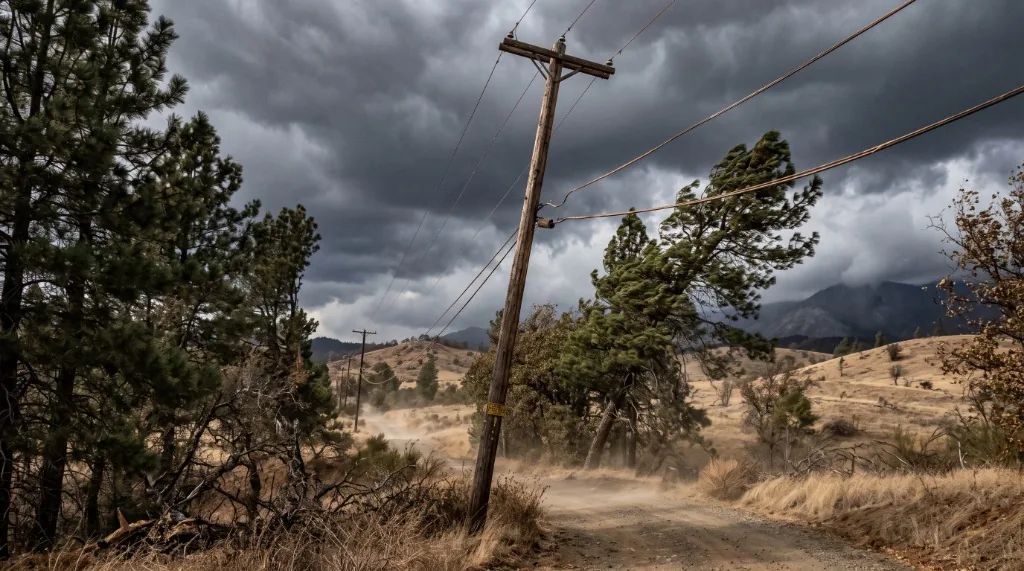
For rural North State communities, modest autumn breezes frequently trigger extended blackouts. Behind the recurring darkness lies an intricate collision of volatile terrain, catastrophic fire liabilities, hyper-sensitive fast-trip breakers, and billions in disputed grid-hardening investments.
SHASTA COUNTY, California — For newcomers arriving in Shasta County from the windswept plains of Texas or the desert valleys of Arizona, the first autumn windstorm often brings an unexpected shock.
Back home, gale-force gusts topping 50 or 60 miles per hour might rattle road signs and bend palm trees without interrupting dinner. But here in the rural foothills surrounding Redding—in communities like Palo Cedro, Shingletown, Igo, Ono, Whitmore, and Happy Valley—a routine 25-mph breeze can plunge entire neighborhoods into darkness for hours or even days.
The recurring outages prompt an understandable, frustrated question among residents: Is Northern California’s electrical infrastructure so fragile that an ordinary gust of wind can take down the grid?
The answer is complex. The issue is not simply the structural strength of wooden poles or the thickness of overhead copper wire. Rather, it represents an intersection of uniquely volatile geography, a history of catastrophic utility-sparked wildfires, corporate liability management, and a regulatory tug-of-war over how—and where—billions of ratepayer dollars are spent to modernize the grid.
A Tale of Two Grids: City Limits vs. Rural Foothills
To understand why Shasta County experiences outages so unevenly, one need only look across the municipal boundary of Redding.
Inside city limits, residents are powered by the Redding Electric Utility (REU), a municipal, publicly owned electric utility that has operated since 1921. While severe winter storms can knock down localized branches, REU customers rarely, if ever, experience proactive safety shutoffs. The city’s compact urban footprint, dedicated municipal maintenance crews, and distinct grid architecture allow it to weather gusty conditions with minimal disruption.
Cross the boundary into unincorporated Shasta County, however, and service shifts almost entirely to investor-owned utility Pacific Gas and Electric Company (PG&E). Here, thousands of miles of overhead distribution and transmission lines stretch across rugged canyons, steep mountain passes, and sprawling rural acreage.
For these rural customers, keeping the lights on has become an unpredictable ordeal during Northern California’s extended fire season, which typically stretches from late spring through November.
PSPS vs. EPSS: Two Very Different Types of Shutoffs
Much of the public frustration stems from confusion between two distinct safety mechanisms deployed across rural circuits: Public Safety Power Shutoffs (PSPS) and Enhanced Powerline Safety Settings (EPSS).
1. Public Safety Power Shutoffs (PSPS)
A Public Safety Power Shutoff (PSPS) is a proactive, planned event. Under rules overseen by the California Public Utilities Commission (CPUC), utilities can de-energize lines in designated high-fire-threat districts when weather models predict critical fire danger.
According to local emergency planning guides from Shasta County Ready, these proactive shutoffs are triggered by a combination of factors:
National Weather Service (NWS) Red Flag Warnings;
Sustained winds above 25 mph and gusts exceeding 40 to 45 mph;
Critically low relative humidity levels (often under 10%–15%);
Tightly measured fuel moisture levels in dead grass, brush, and timber.
While utilities attempt to give customers 24 to 48 hours of advance warning before a PSPS event, the outages remain profoundly disruptive, forcing schools to close, businesses to idle, and well-water pumps to shut down.
2. Enhanced Powerline Safety Settings (EPSS)
The sudden, unexplained shutoffs on days with modest 20-mph breezes are typically caused by Enhanced Powerline Safety Settings (EPSS), also known as "fast-trip" settings.
Introduced by PG&E across high-risk wildfire areas following the catastrophic blazes of 2017–2021, EPSS essentially recalibrates automated circuit breakers into hyper-sensitive safety trips. On an ordinary suburban power line, if a small pine branch or bird momentarily brushes against a wire, the breaker may "fault" for a split second and attempt to re-energize itself automatically.
Under EPSS settings, the line cuts power in as little as one-tenth of a second—before an electric arc can fall to dry brush below.
While PG&E reports that EPSS has reduced ignitions on enabled circuits by more than 65%, the trade-off is reliability:
No advance warning: Power cuts instantaneously.
Lengthy restoration: State safety rules prohibit utility operators from remotely turning the power back on. Utility crews must physically patrol the entire length of the circuit—often traversing miles of steep, heavily vegetated backwoods on foot or by helicopter—to confirm no branch is hanging on a wire before throwing the switch back on.
A breezy afternoon that sends small twigs into an overhead line can turn into an unexpected 8-to-12-hour blackout while line crews navigate rugged terrain.
The Shadow of the Zogg Fire and Past Catastrophes
The aggressive use of safety shutoffs did not emerge in a vacuum. It is the direct consequence of a decade of deadly, utility-caused infernos that leveled communities, cost billions of dollars in liabilities, and pushed California’s largest utility through bankruptcy.
For residents of Shasta County, the danger is personal. On September 27, 2020, during a high-wind event, a gray pine tree located on private property fell onto a 12,000-volt PG&E distribution line along Zogg Mine Road near Igo.
According to the official investigation by CAL FIRE, the contact ignited dry grass beneath the line. Pushed by fierce north winds, the Zogg Fire exploded across 56,338 acres, destroyed 204 structures, and claimed the lives of four local residents, including a mother and her eight-year-old daughter attempting to evacuate.
In 2023, PG&E finalized a $50 million civil settlement with the Shasta County District Attorney’s Office to resolve criminal charges stemming from the fire, funding local fire districts, law enforcement, and emergency infrastructure.
Combined with memories of the 2018 Camp Fire in neighbouring Butte County—which killed 85 people and decimated the town of Paradise after an eighty-year-old transmission line hook failed in high winds—the regulatory and legal calculus changed permanently. For utility executives and state regulators, the inconvenience of dark homes is viewed as preferable to the catastrophic liability of another deadly wildfire.
Why 25 MPH in Shasta County Is Not 25 MPH Elsewhere
Out-of-state transplants often question why 25-mph wind speeds cause panic in Northern California when midwestern or southwestern power grids handle higher velocities routinely. The answer lies in Shasta County's topography and fuel load:
The 'Horseshoe' Wind Funnel: Shasta County sits at the northern terminus of the Great Sacramento Valley, ringed on three sides by the Klamath Mountains, the Cascade Range, and the northern Sierra Nevada. When high-pressure systems build over the Great Basin, dry air plunges over the mountains and accelerates south down the Sacramento River canyon. This creates localized diabatic wind tunnels where winds at ridge level are significantly stronger than what home weather stations measure on the valley floor.
Volatile Fuel Bed: Summer temperatures in Redding regularly exceed 100°F for weeks on end, baking vegetation until fine dead fuel moisture drops into the single digits—drier than kiln-dried lumber.
Tree Species and Dieback: The foothill terrain features extensive stands of foothill gray pines and black oaks intermingled with manzanita and chamise. Gray pines are notoriously brittle and prone to sudden limb drop during moderate wind gusts, especially after years of prolonged drought and bark beetle infestation. A 25-mph gust that would bend an oak in Texas can snap an overhanging drought-stressed pine bough in Shingletown or Igo.
The Infrastructure Debate: Hardening, Undergrounding, and Rates
While residents understand wildfire danger, patience with frequent shutoffs is wearing thin—particularly as monthly utility bills have reached historic highs.
A major flashpoint among local homeowners is the pace and equity of long-term grid hardening. PG&E initially pledged to bury 10,000 miles of powerlines across its service territory to virtually eliminate ignition risk and restore grid reliability under its System Hardening and Undergrounding program.
However, burying lines costs roughly $3 million to $4 million per mile. In its landmark ruling on PG&E's General Rate Case (GRC), the CPUC approved funding to underground approximately 1,230 miles while prioritizing 778 miles of covered conductors (insulated overhead wire) and aggressive tree trimming as a faster, more cost-effective alternative.
For many rural Shasta County property owners, the reality on the ground feels frustrating:
New Wooden Poles Without Undergrounding: Residents in several working-class and rural communities report seeing replacement wooden poles and overhead lines installed along easements, signaling that undergrounding may not arrive in their areas for decades—if ever.
The Generator Paradox: Extended shutoffs have driven thousands of rural families to purchase portable gasoline or diesel backup generators. Fire marshals and emergency responders note that operating portable generators in tinder-dry brush during red-flag wind conditions presents its own serious hazard of equipment fires, fuel spills, and carbon monoxide poisoning.
Economic Toll: For families living on fixed incomes in places like Bella Vista or Round Mountain, multiple-day shutoffs mean spoiled groceries, lost productivity for remote workers, and added fuel costs running backup generators—all while paying some of the highest per-kilowatt-hour residential electricity rates in the continental United States.
What Lies Ahead for Shasta County
As Northern California navigates fire seasons shaped by climatic extremes, the tension between public safety and utility reliability remains unresolved.
For rural Shasta County, shutoffs during moderate wind gusts have become the default fire-prevention strategy. Until insulated conductors, underground lines, and localized microgrids replace aging bare-wire circuits throughout the foothills, residents must prepare for the wind to remain synonymous with blackouts.
Local emergency managers recommend that all households in rural zones maintain emergency preparedness kits, register for landline and mobile alerts through local emergency portals, and prepare medical and refrigeration contingency plans well before the north winds blow down the valley.