The Activist in the Registrar's Office: Inside Laura Hobbs’ Path Through Shasta County Politics
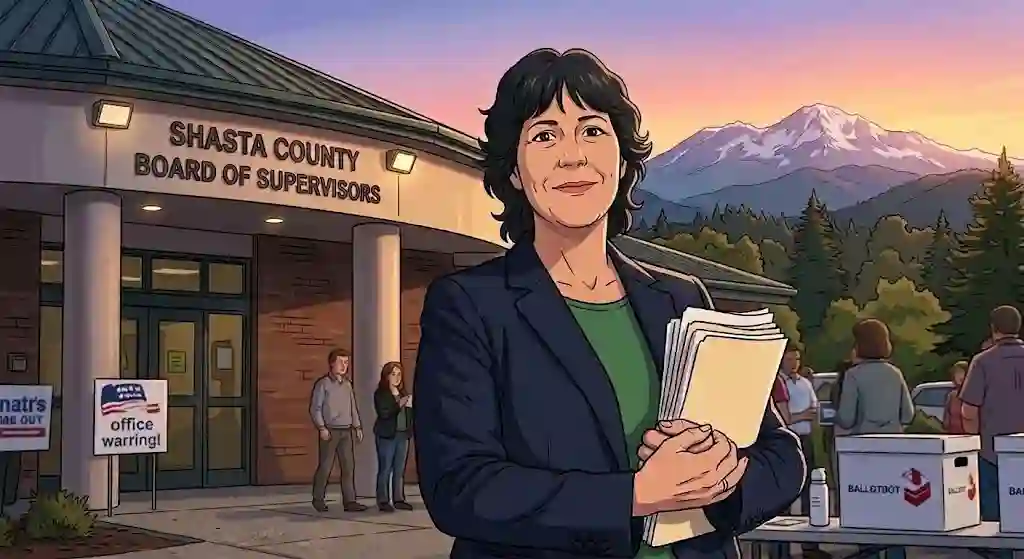
From microbiology researcher and citizen podium analyst to supervisorial candidate, Measure B co-sponsor, and internal elections analyst—the five-year political trajectory of Dr. Laura Hobbs reflects Shasta County's wider institutional battle over election administration.
REDDING, Calif. — Over the past five years, Shasta County has served as a central focal point in California’s debates over election administration, local self-governance, and state statutory authority. At the heart of these controversies stands Dr. Laura Hobbs.
Holding a doctorate in microbiology, Hobbs entered county civic life not as a traditional candidate, but as a citizen researcher presenting spreadsheets and cast-vote analyses at the Board of Supervisors’ public comment podium. Over a five-year span, Hobbs transformed from an activist questioning digital tabulation machinery into an "America First" candidate for District 2 County Supervisor, a co-sponsor of the Measure B county charter initiative, and an internal analyst inside the Shasta County Registrar of Voters office.
Her trajectory reflects the wider institutional friction across Shasta County: a clash between grassroots movements seeking fundamental changes to local voting procedures and an administrative and legal system bound by statewide election statutes.
I. Scientific Background and Entry into Local Politics
Before arriving in Shasta County around 2021, Laura Hobbs spent her career outside the political arena. Between 2006 and 2013, Hobbs conducted graduate and postdoctoral research at the University of California, Riverside, authoring or co-authoring 11 peer-reviewed papers in microbiology, bacterial kinetics, and predictive modeling. Following her academic career, Hobbs spent eight years as a stay-at-home mother caring for her children—a role she cited on official nomination paperwork when listing her formal ballot designation as "Parent."
Hobbs relocated to Northern California during a period of regional demographic and political change accelerated by the COVID-19 pandemic. When she began attending Shasta County Board of Supervisors meetings, she stood out by framing her electoral skepticism around quantitative data rather than conventional political talking points.
Taking to the public-comment lectern, Hobbs regularly utilized the chamber’s overhead document projector to display precinct-level analyses, mathematical ratios, and voting-machine audit logs. Citing California Elections Code § 12270, Hobbs argued that decentralized, precinct-level manual counting was legally viable and offered greater transparency than commercial optical-scan systems.
As reported by Talking Points Memo, Hobbs’ analytical presentations found an audience among the board's conservative majority—Supervisors Patrick Jones, Kevin Crye, and Chris Kelstrom. Her presentations contributed to the public record leading to the board’s divided 3–2 vote in March 2023 to terminate the county's contract with Dominion Voting Systems.
While Hobbs’ technical style earned praise from local election-integrity groups, her public appearances also generated controversy. Critics, including regional liberal watchdogs and left-leaning supervisors, contended that her statistical analyses misunderstood standard auditing methodologies and promoted unfounded doubt in certified equipment. The friction intensified during a February 2024 meeting reported by A News Café, when Hobbs used public comment to confront incumbent District 3 Supervisor Mary Rickert, alleging that numbers on Rickert's state-issued license plate held spiritual significance—an exchange that underscored how deeply personal the county's political divisions had become.
II. The 2024 Supervisorial Primary and the 14-Vote Margin
In late 2023, Hobbs filed to run for the open District 2 supervisorial seat being vacated by Tim Garman, entering a four-candidate primary against retired Redding Police Captain Allen Long, business professor Dan Sloan, and education field representative Susanne Baremore.
Hobbs campaigned on an "America First" platform, advocating for the elimination of digital tabulators, the implementation of local voter photo identification, and greater fiscal resistance to state mandates. Her candidacy drew national attention when she was formally endorsed by MyPillow chief executive Mike Lindell.
According to campaign disclosures audited through the Shasta County Local Campaign Finance Disclosure Portal and investigative mapping by North State Breakdown's Follow the Money Project, Hobbs built an interconnected local fundraising base:
Civic activist and measure co-organizer Kari Chilson provided Hobbs’ largest individual donation of $7,500.
Conservative donors Bev Gray ($1,798) and Jim Burnett ($1,139) contributed to Hobbs while financing allied conservative campaigns, including Patrick Jones' supervisorial committee.
Regional political spending aligned with the network of former vineyard owner Reverge Anselmo contributed to digital campaigns and independent expenditure efforts targeting moderate candidates in the race.
The primary campaign was characterized by intense internal competition for conservative votes. The Shasta County Republican Central Committee endorsed Dan Sloan rather than Hobbs, while anonymous opposition dossiers targeted both Sloan and supervisorial candidate Matt Plummer.
On March 5, 2024, the primary produced one of the closest outcomes in recent county history:
| Candidate | Ballot Designation / Platform | Votes | Percentage | Outcome |
|---|---|---|---|---|
| Allen Long | Retired Police Lieutenant; Institutional Moderate | 5,410 | 50.13% | Elected Outright |
| Laura Hobbs | Parent / Hand-Count & Election Integrity Advocate | 2,063 | 19.12% | Eliminated |
| Dan Sloan | Professor; Conservative | 1,995 | 18.49% | Eliminated |
| Susanne Baremore | Education Field Representative | 1,324 | 12.26% | Eliminated |
Under California county elections law, a candidate who secures more than 50% of the vote in the primary wins the seat outright, avoiding a November runoff. With the anti-establishment vote divided between Hobbs and Sloan, Long cleared the majority threshold by just 14 votes.
III. Recount Procedures and Hobbs v. Long
Following the certification of the March primary, Hobbs challenged the final result. On April 4, 2024, she filed an administrative request with Assistant Registrar Joanna Francescut for a full manual recount of District 2 ballots under California Elections Code § 15620.
Under state law, a requesting candidate must deposit funds daily to cover actual county operational expenses. The elections department calculated a daily deposit requirement of $8,626.67 to stage the count, staff tally boards, and secure chain-of-custody protocols.
However, as reported by Democracy Docket, when Hobbs arrived on the morning of April 8, she canceled the recount before counting began. Hobbs stated she objected to the department's plan to run ballots through electronic scanners to sort them prior to manual inspection, arguing that relying on disputed machines invalidated the process, while county officials noted that machine sorting was standard administrative procedure under state guidelines.
Hobbs subsequently retained constitutional attorney Alexander Haberbush of the Lex Rex Institute and filed a formal election contest in Shasta County Superior Court (Hobbs v. Long, Case No. 24CV-0204675). The lawsuit asserted that voting equipment calibration anomalies and chain-of-custody lapses affected the 14-vote margin, asking the court to order a new election under the Fourteenth Amendment.
The petition relied on declarations from researcher Richard Umfleet, who analyzed Hart InterCivic audit logs to allege processing delays and timestamp inconsistencies. County counsel and Long’s defense team moved to dismiss the contest, arguing that Umfleet lacked formal qualifications in computer forensics and that the petition failed to identify any specific illegal ballots.
During hearings in May 2024, Shasta County Superior Court Judge Stephen H. Baker raised pointed concerns regarding the petition's lack of diligence and procedural defects. On June 25, 2024, Judge Baker dismissed the contest with prejudice, ruling that the petitioner had provided insufficient competent evidence to overcome the statutory presumption of official regularity governing certified returns.
IV. The Genesis and Legal Battles of Measure B
Following the dismissal of the supervisorial challenge, Hobbs and fellow activists turned to the citizen initiative process.
In October 2023, Governor Gavin Newsom had signed Assembly Bill 969 (AB 969) as emergency legislation. The law prohibited California counties from using manual hand tallies as the primary counting method in elections with more than 1,000 registered voters, effectively halting Shasta County’s plan to eliminate tabulators.
In response, Hobbs joined Richard "Rich" Gallardo, Kari Chilson, Deidre Holliday, and Jim Burnett—a coalition frequently identified as the "Shasta 5"—under the committee name "Save Shasta Elections." Exercising charter county petition provisions, they authored the "Local Election Transparency and Security Reform" initiative, which became Measure B.
The measure proposed four major alterations to county elections:
Mandatory Precinct Hand Counting: Requiring election-night manual tallies by four-person citizen volunteer teams, replacing digital tabulators;
Local Voter ID: Mandating government-issued photo identification at polling sites;
Restricted Mail-In Balloting: Limiting mail-in voting strictly to active-duty military, overseas voters, and medically infirm electors; and
Air-Gapped Registration Rolls: Severing county voter registration lists from online networks and the statewide VoteCal system.
Convinced that the initiative was preempted by state law, Shasta County Counsel Joseph Larmour filed a preemptive lawsuit in March 2025 (County of Shasta v. Hobbs, et al., Case No. 25CVG00515). Larmour sought declaratory relief to excuse the county from issuing an official title and summary, arguing that doing so would mislead voters regarding the county charter's authority to override state statutes.
Proponents represented by Haberbush argued that California Elections Code § 9105 imposes a nondiscretionary, ministerial duty on county counsel to issue a title and summary regardless of legal opinions on a measure’s constitutionality. On March 19, 2025, Superior Court Judge Benjamin Hanna ruled against the county, holding that pre-circulation emergency challenges were procedurally improper and ordering Larmour to issue the title and summary within 24 hours. As documented by A News Café’s legal coverage, the county subsequently dropped the lawsuit, allowing signature circulation to proceed.
V. Transition Inside the Elections Department
While Measure B was circulating, the administrative leadership of Shasta County’s elections office underwent a significant change.
In February 2024, longtime Registrar Cathy Darling Allen announced her early retirement, citing severe workplace stress and medical concerns. Following interim leadership, the Board of Supervisors' conservative majority appointed software developer and attorney Clint Curtis as County Clerk and Registrar of Voters in April 2025.
Upon taking office, Curtis restructured operations and hired Dr. Laura Hobbs as an Elections Analyst and Candidate Filing Coordinator at an annualized salary between $79,800 and $101,170.
Hobbs’ hiring placed an active election litigant and charter measure sponsor in an official administrative role. Candidates scheduling nomination appointments via the Shasta County Candidate Filing Portal coordinated directly with Hobbs (lhobbs@shastacounty.gov).
Her dual position generated immediate scrutiny and subsequent procedural disputes:
The Signature Certification Controversy: Proponents submitted over 10,000 signatures for Measure B. A statistical sample conducted by civil service staff projected an 86% validity rate, which fell below the statutory threshold required to qualify a charter amendment. However, as documented in Katske v. Shasta County and reported by North State Breakdown, Registrar Curtis certified the measure by applying the lower signature threshold governing general county ordinances, allowing Measure B onto the June 2026 ballot.
The Voter Information Guide Dispute: In May 2026, elections office staff initially refused to accept a timely opposition rebuttal to Measure B. When the official Voter Information Guide was mailed, the rebuttal text was printed, but the names and titles of all five opposition signers—including a former county counsel and retired supervisor—were omitted from page 30 of the guide, drawing allegations of administrative favoritism.
VI. The Canvass Confrontation and Whistleblower Disclosures
Tensions between the Registrar’s office and county executive leadership culminated during the post-election canvass of the June 2, 2026 primary.
On Saturday, June 6, 2026, the Board of Supervisors scheduled an emergency 5:00 p.m. closed session to discuss initiating litigation concerning the elections department. During open public comment, Hobbs addressed the board, identifying herself as an elections analyst and agency whistleblower.
Hobbs stated that County Counsel Joseph Larmour had pulled her away from completing statutory reporting for the California Secretary of State to question her regarding Curtis's management. Approximately one minute into her remarks, county staff muted her microphone. When Hobbs continued speaking unamplified, Larmour cited California Penal Code § 403 regarding the disruption of a public meeting and summoned sheriff's deputies. Hobbs left the podium and returned to the elections office across the street before law enforcement arrived.
The following morning, June 7, independent news outlet Shasta Unfiltered published Hobbs’ sworn whistleblower memorandum, sent directly to County Auditor-Controller Nolda Short.
Hobbs’ declaration alleged that county leadership was conducting improper interrogations that disrupted mandatory state reporting. Her memo also detailed internal friction among staff, including a June 4 incident where an elections supervisor allegedly withheld official ballot issue receipts in a personal bag and locked them in a cabinet until Curtis intervened.
Conversely, administrative leadership maintained that inquiries were lawful and necessary to investigate serious operational concerns inside the department.
VII. Legal Injunctions, Administrative Censure, and Electoral Fallout
The administrative and legal conflicts unresolved during the primary quickly moved toward legal and political conclusions across late 2026:
Workplace Misconduct Findings: An independent investigation conducted for the county by Oppenheimer Investigations Group LLP substantiated workplace misconduct allegations against Curtis, finding that he had engaged in unprofessional remarks, made campaign calls during county hours, and retaliated against personnel who participated in internal reviews.
The Ballot Vault Standoff: In the summer of 2026, Curtis installed personal padlocks on the ballot vault containing 2024 and 2026 ballots, declaring that accessing them would require "a warrant and bolt cutters" while claiming ballots were being preserved for federal inquiries.
State Intervention and Measure B Injunction: Shasta County voters approved Measure B on June 2, 2026, by a margin of 55.6% to 44.4%. On June 12, 2026, California Attorney General Rob Bonta and Secretary of State Shirley Weber filed a petition for a writ of mandate against Shasta County (Weber v. County of Shasta). In August, Superior Court Judge Benjamin Hanna issued a preliminary injunction barring Measure B from taking effect, affirming that local charter provisions cannot preempt uniform statewide election codes governing voting and tabulation.
Board Censure: On August 11, 2026, the Board of Supervisors voted 3–1 to censure Clint Curtis for failure to execute statutory duties and administrative insubordination, as recorded in the Shasta County Meeting Archive.
Electoral Shift: In the June 2, 2026 primary election, former Assistant Registrar Joanna Francescut defeated Curtis for the permanent Registrar of Voters seat with 58% of the vote, signaling an administrative return to traditional civil service leadership.
Conclusion
Dr. Laura Hobbs’ trajectory through Shasta County government illustrates the complex dynamics that unfold when outside election integrity activism intersects with local public administration.
To her supporters, Hobbs represented an analytical outsider who applied rigorous scientific standards to examine electronic voting systems, challenged an entrenched County Counsel, and championed local self-determination through Measure B. To her critics and County Counsel, her actions represented a destabilizing force that burdened county departments with costly litigation, bypassed civil service merit protections, and advanced proposals that ran counter to California election law.
Ultimately, Hobbs’ progression—from public comment speaker to supervisorial candidate, charter initiative co-author, and internal elections analyst—remains one of the most thoroughly documented case studies of grassroots election contestation and institutional response in modern California history.