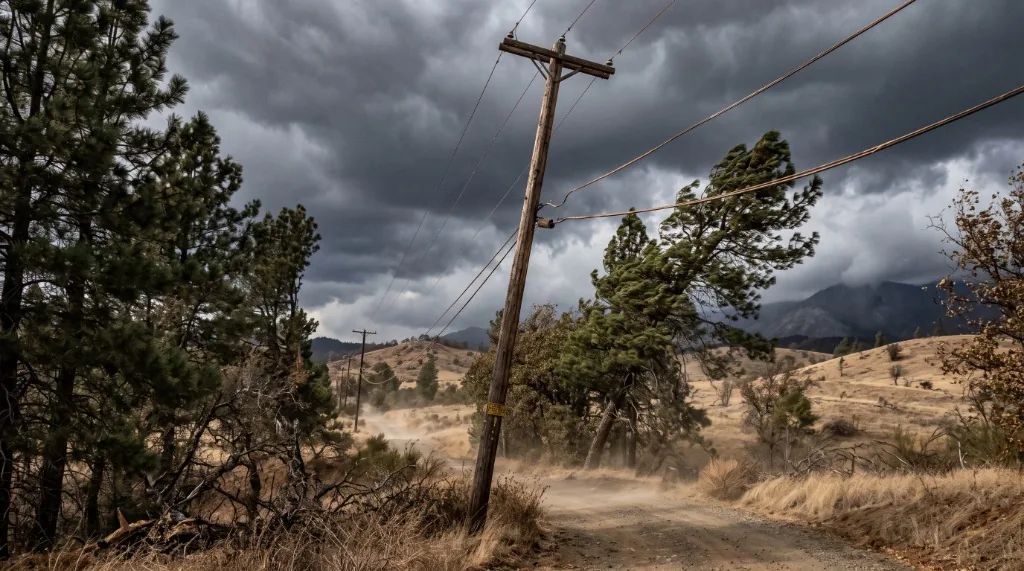
Taps Running Dry: How Wildfires, Failing Pumps, and Tax Liens Pushed Shasta County’s Rural Water Systems to the Brink
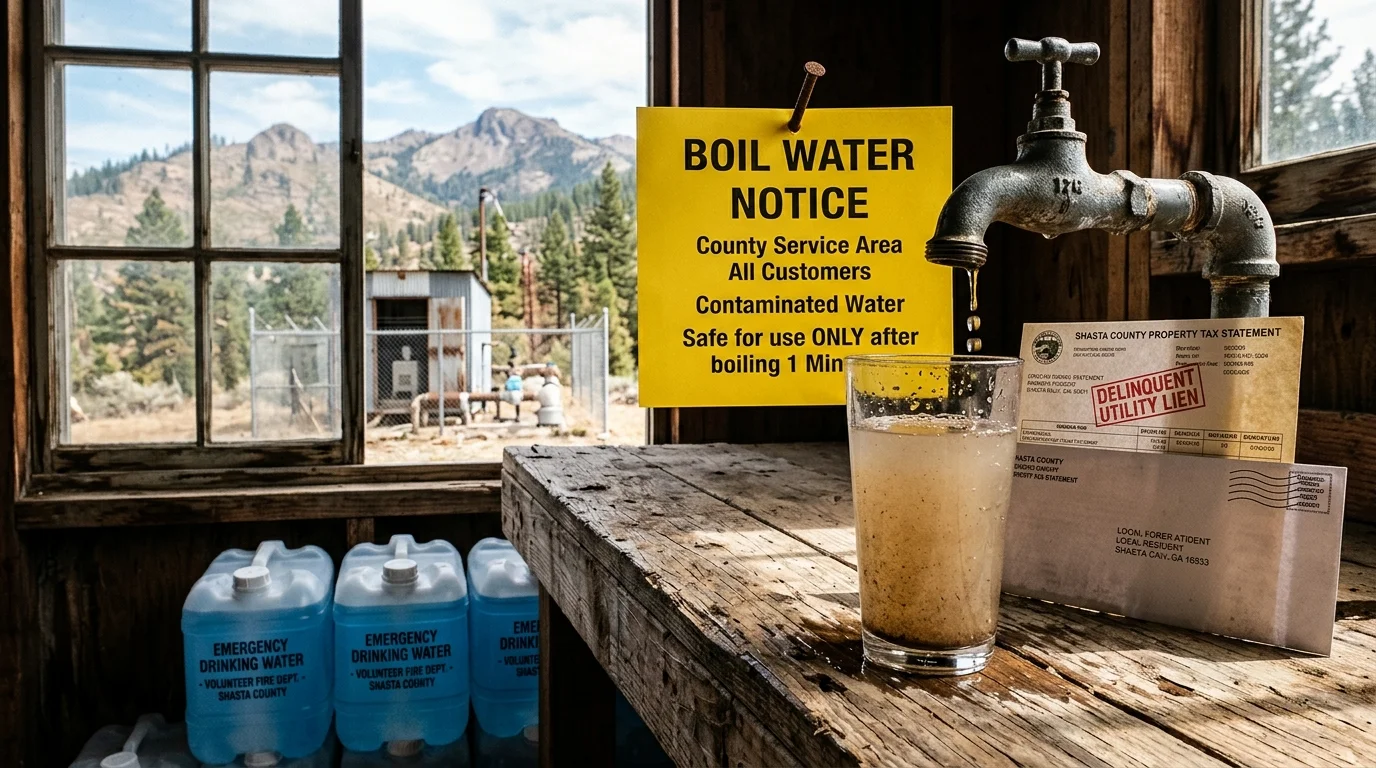
While supervisors spar in Redding over political appointments, unincorporated communities from Castella to Jones Valley face emergency boil water orders, strict bottled water rationing, and aggressive property tax liens for water they never received.
REDDING, California — In the rugged foothills and river canyons surrounding Redding, a quiet, multi-front utility collapse is testing the limits of rural endurance. Over the past several weeks, thousands of Shasta County residents living outside municipal water grids have watched their taps sputter dry, carried home emergency water rations from volunteer fire halls, and opened property tax statements containing thousands of dollars in surprise county liens.
Public records obtained from the California State Water Resources Control Board (SWRCB) and county administrative dockets reveal an accelerating infrastructure crisis spanning multiple County Service Areas (CSAs) and rural utility districts. From chronic depressurization and pathogen risks in the north to catastrophic pump failures and carcinogenic groundwater spikes in the south, Shasta County’s rural utility architecture is buckling under mechanical obsolescence, wildfire destruction, and decades of deferred maintenance.
Yet rather than delivering emergency relief or state subsidies, the Shasta County Board of Supervisors responded in late September by leveraging a powerful bureaucratic debt mechanism: converting delinquent rural utility bills into property tax liens, threatening struggling homeowners with accelerated tax foreclosure.
Castella: Depressurization, Pathogens, and the Canyon Squeeze
For the mountainous community of Castella along the upper Sacramento River canyon, the crisis arrived with the sudden loss of water pressure.
Castella relies on Shasta County Service Area #3 (CSA #3), a fragile surface water system that pulls water directly from Castle Creek, according to Shasta County Public Works records. Surface water intakes are notoriously sensitive to environmental disruption, requiring constant positive hydraulic pressure to keep external contaminants from seeping through aging joints and fissures.
On October 5, 2026, the system gave out. The SWRCB Division of Drinking Water, alongside Shasta County Public Works, issued an emergency, mandatory Boil Water Notice (PWS No. 4500015) for all Castella residents.
When water lines depressurize below the state regulatory minimum of 20 pounds per square inch (psi), a dangerous vacuum is created, pulling surrounding soil bacteria, agricultural runoff, and microbiological pathogens (E. coli and Cryptosporidium) directly into potable lines. The state directive ordered families to bring all tap water to a rolling boil for at least one minute before drinking, cooking, or brushing teeth, or to rely on chemical disinfection tablets.
The timing could hardly have been worse. As utility coordinator Scott Sealander and state staff engineer Michael Burgess initiated emergency line flushing, northern Shasta County was besieged by dry lightning fires. The Fork Fire ignited off East Fork Road in French Gulch, burning through steep terrain, while the Cabin Fire sparked near Girard Ridge directly above the Castella watershed.
The fires forced Caltrans and the California Highway Patrol to shut down Interstate 5 in both directions from Fawndale Road north to Mott Road, alongside a total shutdown of the Union Pacific rail line due to track damage. With the primary canyon artery severed, transporting heavy pump replacement parts, chemical filtration media, or bulk potable water tankers into Castella was effectively blocked, leaving the community cut off and boiling water over camp stoves.
The October breakdown is not an isolated incident. Public records document an alarming pattern: CSA #3 suffered nearly identical system-wide outages and boil water advisories in January 2023 and again in July 2025, underscoring an intake architecture operating on borrowed time.
Jones Valley: The Zero-Redundancy Disaster
Forty miles southeast on the shores of Shasta Lake, the 2,006 residents of Jones Valley faced a sudden, complete mechanical failure.
Jones Valley’s water is managed by Shasta County Service Area #6 (CSA #6), which pumps raw surface water out of Lake Shasta up into localized storage tanks. On September 30, 2026, the station’s sole primary pump suffered a catastrophic mechanical breakdown.
In municipal utility engineering, critical lifelines rely on "N+1 redundancy"—ensuring a secondary backup pump can instantly engage when primary equipment fails. CSA #6 had no such backup. When the pump died, reserve storage rapidly depleted, and the entire district’s distribution network went dry.
County administrative records show that county leadership was intimately aware of the pump station’s extreme fragility. Throughout 2022, the Shasta County Board of Supervisors passed a continuous sequence of emergency declarations—including Resolution No. 2022-004 and Resolution No. 2022-042—acknowledging the urgent need for emergency pump replacements and structural modifications in Jones Valley. Yet four years later, no permanent redundancy was ever installed.
The failure forced Shasta County into emergency rationing. From September 30 through October 2, 2026, residents were directed to the Jones Valley Volunteer Fire Department on Ravine Road, where county staff rationed strictly one case of bottled drinking water per household.
For household sanitation, the county opened a non-potable hose at a fire hydrant on Elk Trail East, warning residents that the water was completely unfit for consumption and requiring elderly and disabled residents to haul 5-gallon buckets of untreated water to flush toilets.
"People moved out here for independence, but having to stand in line at a volunteer fire station for a single flat of bottled water just to make coffee or rinse dishes is humiliating," said one Jones Valley resident who asked not to be named. "We pay our taxes. Where did the maintenance money go?"
Cottonwood: The Multi-Million-Dollar Carcinogen Threat
In southern Shasta County, the Cottonwood Water District is battling an invisible and expensive crisis below ground.
Unlike the surface intakes of Castella and Jones Valley, Cottonwood relies on deep groundwater aquifers. During regulatory sampling of the district’s well assets, Operations crews confirmed that Well 10 tested positive for Hexavalent Chromium (Chromium-6) above the state’s legal limit.
Earlier this year, California became the first state in the nation to enact a strict Maximum Contaminant Level (MCL) of 10 micrograms per liter (10 µg/L) for Chromium-6. Widely known as the toxic compound highlighted in the Erin Brockovich litigation, Hexavalent Chromium is an aggressive, odorless industrial and geological carcinogen linked to stomach, intestinal, and bladder cancers.
A secondary confirmation test verified that Well 10 exceeded the 10 µg/L threshold, legally triggering a state-mandated Compliance Plan with a hard deadline to achieve full mitigation by October 2028.
Standard chlorination and sand filtration cannot remove heavy metals. Compliance requires massive capital investments: either industrial-scale Strong Base Anion (SBA) ion-exchange systems or commercial Reverse Osmosis (RO) plants. While Cottonwood successfully secured a $500,000 grant through California’s Drinking Water State Revolving Fund (DWSRF Project 2700), engineering estimates for a single municipal Chromium-6 treatment facility run between $2 million and $5 million.
The small district faces a brutal fiscal reality: take on millions in debt to build the plant—passing crushing rate hikes onto a rural, fixed-income community—or shut down Well 10 entirely, drastically cutting water supplies in an area already plagued by leaking distribution pipes and emergency main shutoffs along Freedom Boulevard.
Resolution R5: Turning Dry Taps into Tax Foreclosures
While rural families grappled with bottled water rations and contamination notices, the Shasta County administration took decisive action—not to replace failing infrastructure, but to collect unpaid bills.
During their September 24, 2026 public session, the Shasta County Board of Supervisors held a formal hearing on Resolution R5.
The resolution authorized the county to take roughly $177,000 in delinquent water fees and uncollectible debts across County Service Areas—primarily hitting Palo Cedro (CSA #8), French Gulch (CSA #11), and Jones Valley (CSA #6)—and transfer them directly onto the county property tax roll as secured municipal tax liens for the 2026–27 fiscal year.
Under California’s "Teeter Plan" accounting system, converting utility arrears into property tax liens provides an immediate windfall to the county: the general fund advances the cash to the utility fund, and the county assumes the legal authority to collect the debt from the homeowner, augmented by punitive late fees and interest.
The impact on homeowners is severe: missing the December 10 property tax deadline triggers an immediate 10% penalty. A second missed deadline in April tacks on an additional 10% penalty plus administrative fees. Unpaid liens default to the county on July 1, accruing an aggressive 1.5% monthly interest penalty (18% annually) under Shasta County Tax Collector regulations. After five years of default, the county exercises its statutory "power to sell," seizing and auctioning the property on courthouse steps.
Most controversial is the situation in Jones Valley. On the exact same week that CSA #6’s single pump collapsed and left families rationing bottled water from the fire hall, the county used Resolution R5 to slap $11,640 in tax liens on parcels in Jones Valley’s Elk Trail subdivision for unpaid "standby charges"—fees charged to property owners simply for having utility pipes running past their land, even if their homes are not hooked up to the system.
In effect, Shasta County taxpayers are facing property liens and potential foreclosure to subsidize utility networks that fail to provide water when the summer heat rises.
The Widening Divide
As Shasta County’s elected leaders spend board sessions debating political resolutions, charter county measures, and executive golden parachutes, the basic mechanical plumbing of the county’s unincorporated communities is giving out.
From the fire-threatened canyons of Castella to the dry lake intake lines of Jones Valley and the carcinogen-tainted wells of Cottonwood, rural Shasta County is learning that independence comes with a steep price tag: boiling your water, standing in line for rations, and paying the county for the privilege.