A $129 Million Bond, Record Enrollments, and Regional Expansions: Shasta County Higher Education Enters High-Stakes Growth Era
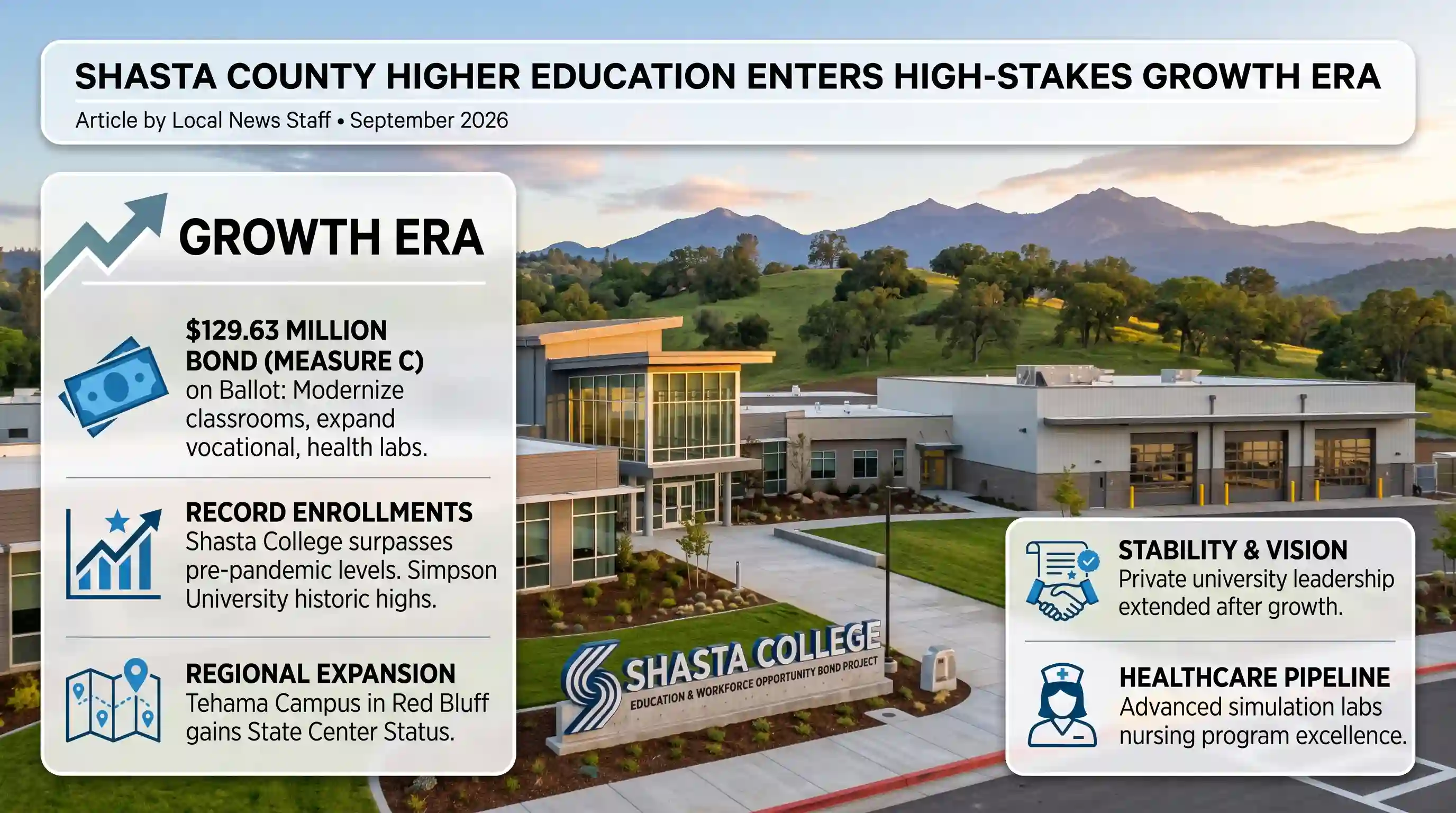
Shasta College places $129.63M Measure C on the ballot and secures center status in Red Bluff, while Simpson University extends President Norman Hall through 2033 after record enrollments.
REDDING, California — Across Shasta County's public and private collegiate halls, higher education administration has entered a major expansion era defined by multi-million-dollar capital campaigns, post-pandemic enrollment rebounds, and critical workforce initiatives.
Leading the institutional push, the Shasta-Tehama-Trinity Joint Community College District (STTJCCD) Board of Trustees voted unanimously to place a $129.63 million general obligation bond—Measure C—on the November 3, 2026 ballot to overhaul aging classrooms, expand vocational facilities, and build healthcare simulation laboratories. The public bond drive coincides with a milestone state designation for the college's Tehama campus, a newly negotiated faculty collective bargaining agreement, and an enrollment surge past 7,500 students.
Concurrently, private higher education in Redding is mirroring that upward trajectory, with Simpson University locking in its executive leadership through 2033 following the largest traditional undergraduate enrollment in the school’s 106-year history.
Measure C: A $129.6 Million Bet on Campus Modernization
On May 13, 2026, the STTJCCD Board of Trustees adopted Resolution No. 2025-26-18, formally submitting Measure C—the Shasta College Education and Workforce Opportunity Bond—to district voters across Shasta, Tehama, Trinity, and portions of neighboring rural counties. Under California Proposition 39, the measure requires a 55% supermajority for passage.
District administrators structured the financial package to avoid increasing overall property tax rates. Measure C is timed to replace the retiring debt service of the district’s 2002 Measure A bond, a $34 million authorization used to acquire satellite campuses. By pairing new debt with retiring liabilities, property owners will maintain an estimated levy rate of $7.76 annually per $100,000 of assessed valuation through 2061. That translates to approximately $2.45 per month for a median residential parcel assessed at $378,000, or $3.25 monthly for a $500,000 parcel.
The district has slated Measure C proceeds for five primary infrastructure priorities:
Comprehensive utility, roofing, and HVAC modernizations alongside Americans with Disabilities Act (ADA) accessibility upgrades across 60-year-old campus facilities.
Construction of a dedicated career and technical education (CTE) facility in Corning.
Development of an instructional classroom complex at the Shasta College Farm.
Expansion of allied health clinical simulation laboratories for Emergency Medical Services (EMS) and Certified Nursing Assistant (CNA) cohorts.
Modernized regional public safety instruction facilities for local first-responder training.
"They’re really not serving our students or our public very well. They were not designed for an educational system, an economy, an entire world that runs on the internet, so the wiring was not there," Shasta College Superintendent/President Dr. Frank Nigro said regarding the campus's aging baseline buildings. "[A bond] really is the only way that we have to raise the kinds of capital funds that would cover the work that we need to have done. We're the only public institution of higher education within 75 miles, and so we have the potential to do an awful lot for the community, but we do need help from the community."
Dr. Nigro also noted the college's debt management record, observing that refinancing earlier bond series saved taxpayers $4.25 million while qualifying the district for nearly $40 million in competitive state matching grants.
The campaign comes as the district closes out its 2016 Measure H bond ($139 million). Independent Proposition 39 financial and performance audits accepted in early 2025 confirmed full compliance with statutory ballot terms.
Associate Vice President of Facilities Theresa Markword reported to the Citizens' Bond Oversight Committee that favorable treasury yields generated over $3.6 million in unallocated surplus interest revenue for future capital projects. State-level facilities work is already underway, including a $6.0 million modernization of the 23,122-square-foot Building 800 (Life and Physical Sciences) on the Redding campus.
Red Bluff Hub Secures Center Status Amid Regional Enrollment Boom
Shasta College’s physical reach across the North State achieved a milestone when the California Community Colleges Board of Governors granted official Educational Center Status to the Tehama Campus in Red Bluff.
The approval, which succeeded on the district's third formal petition, recognizes sustained enrollment and programmatic breadth across the 40-acre campus. Built through Measure A and Measure H funds, the Red Bluff facility houses four instructional buildings, offering 20 certificate tracks and eight associate degree pathways to over 4,000 students.
Crucially, the center generates more than 800 Full-Time Equivalent Students (FTES) annually. Reaching 1,000 FTES by 2029 will unlock dedicated ongoing state operational apportionments to support regional courses permanently.
"Receiving center status acknowledges the unique challenges of providing higher education in a geographically remote, rural region," Dr. Nigro stated following the state board's vote. "We could not have reached this milestone without the wonderful community partnerships and local advocacy to enhance the college-going culture."
The regional expansion aligns with post-pandemic enrollment gains. Administrative figures released in August 2026 confirmed that Shasta College exceeded pre-pandemic baselines, enrolling more than 7,500 students for the Fall 2026 term. The influx marks four straight academic cycles of growth, representing a 24.4% four-year expansion across Shasta, Tehama, and Trinity counties.
Shasta College Economic Footprint (FY 2025–2026):
Total Regional Economic Output: $249,000,000
Regional Jobs Supported: 1,734 jobs
Gross Value Added to Regional GDP: $160,000,000
Annual Direct Institutional Payroll: $60,000,000
Operational & Contract Spending: $56,000,000+
Associate Degree Annual Earnings Premium: $18,944 per graduate
According to an economic impact report prepared with ICS Consulting and peer-reviewed by the Rural County Representatives of California, the college served 3,535 first-generation students, with roughly 6,000 learners paying zero tuition through the California College Promise and 39% receiving financial aid.
"The dollars invested here don’t stop at the College—they move throughout the region, supporting employees, local businesses, families, and other employers," said Dr. Kevin O'Rorke, Associate Superintendent and CEO of North State Together.
Labor Stability and a Cautious Approach to Student Housing
On the operational and labor front, district management and the Shasta College Faculty Association (SCFA/CTA/NEA) executed a comprehensive Tentative Agreement covering compensation and workload formulas through the 2025–2026 academic year.
The agreement resolved workload calculations under Article 4.0 by creating tiered multipliers for large classes and merged online Canvas sections. In-person lectures with 51 to 69 students earn a 1.10x load multiplier, scaling up to 1.55x for enrollments of 120 or more. Online courses scale from 1.20x for 41–54 students up to 2.10x for sections exceeding 100.
The contract also boosted part-time faculty office hour compensation from $30 to $33 per hour (supported by a $192,000 annual pool), allocated $150 per unit for online course conversions, and established a $500 annual apparel allowance for nursing faculty clinical gear.
Curricular updates approved by the Academic Senate include a tuition-free, 12-unit noncredit Competency-Based Education (CBE) certificate in Agricultural Technology for Spring 2027, and the Mathematics 2.0 Associate Degree for Transfer (AS-T) to align with Assembly Bill 928 Cal-GETC requirements.
While academic and labor frameworks stabilized, the college took a cautious posture regarding student housing expansion. Shasta College remains one of only 12 California community colleges operating on-campus dormitories, housing 126 students in Redding.
However, after legislative trailer bills like Assembly Bill 123 shifted state housing grants from direct cash to local lease-revenue bonds—causing peer institutions like College of the Canyons to forfeit a $61.8 million grant over operating-debt fears—Shasta College opted not to incur capital construction liabilities.
Instead, the district channeled state allocations, including $332,599 in 2025–26 and $233,873 in 2026–27 from the Homeless and Housing Insecurity Program, directly into its Hope Housing rapid-rehousing program to provide rent subsidies and emergency grants to low-income and veteran students.
Simpson University Marks Historic Turnaround
In the private higher education sector, Simpson University in Redding marked administrative continuity and institutional growth.
On May 6, 2026, the Simpson University Board of Trustees approved a seven-year contract renewal for President Dr. Norman D. Hall, extending his administration through 2033. Trustees credited Dr. Hall, who took the helm in 2018, with guiding the university through its "Simpson Rising" strategic turnaround, which reversed historical financial deficits and positioned the campus for capital expansion.
"The seven-year commitment is an assertion about our future with President Hall, a future of further stability and growth, the development of programs essential to the success of our students and the North State," the board stated.
The contract extension arrived alongside enrollment milestones. In September 2026, Simpson reported enrolling approximately 840 traditional undergraduates for the Fall 2026 term—the highest undergraduate headcount in the institution's history. Undergraduate enrollment has grown by 56% since 2018, while new student enrollment expanded by more than 70% over the same eight-year timeframe. The university's adult ASPIRE degree completion program expanded by 15%, alongside 345 graduate and professional students.
Under Provost Dr. Michael Salmeier, the university launched a Bachelor of Arts in Global Studies and established a $7.5 million Business, Engineering, and Technology division. The Betty M. Dean School of Nursing was recognized as California's top-ranked private BSN program, graduating roughly 90 registered nurses annually into regional medical systems.
Sustaining the North State's Talent Pipeline
The parallel expansions at Shasta College and Simpson University highlight a regional higher education network aligning its programs with rural Northern California's economic needs.
Whether through Shasta College’s $129.6 million Measure C bond to modernize aging technical wings, the expansion of the Red Bluff educational hub, or Simpson University’s private investment in engineering and healthcare, local colleges are preparing to meet the North State’s future workforce demands.
When district voters head to the polls on November 3, Measure C will test whether the community is ready to fund the next generation of public campus modernization.