River Trails Cleared, Storefronts Crowded: Inside Redding and Shasta County’s Post-Grants Pass Homelessness Crackdown
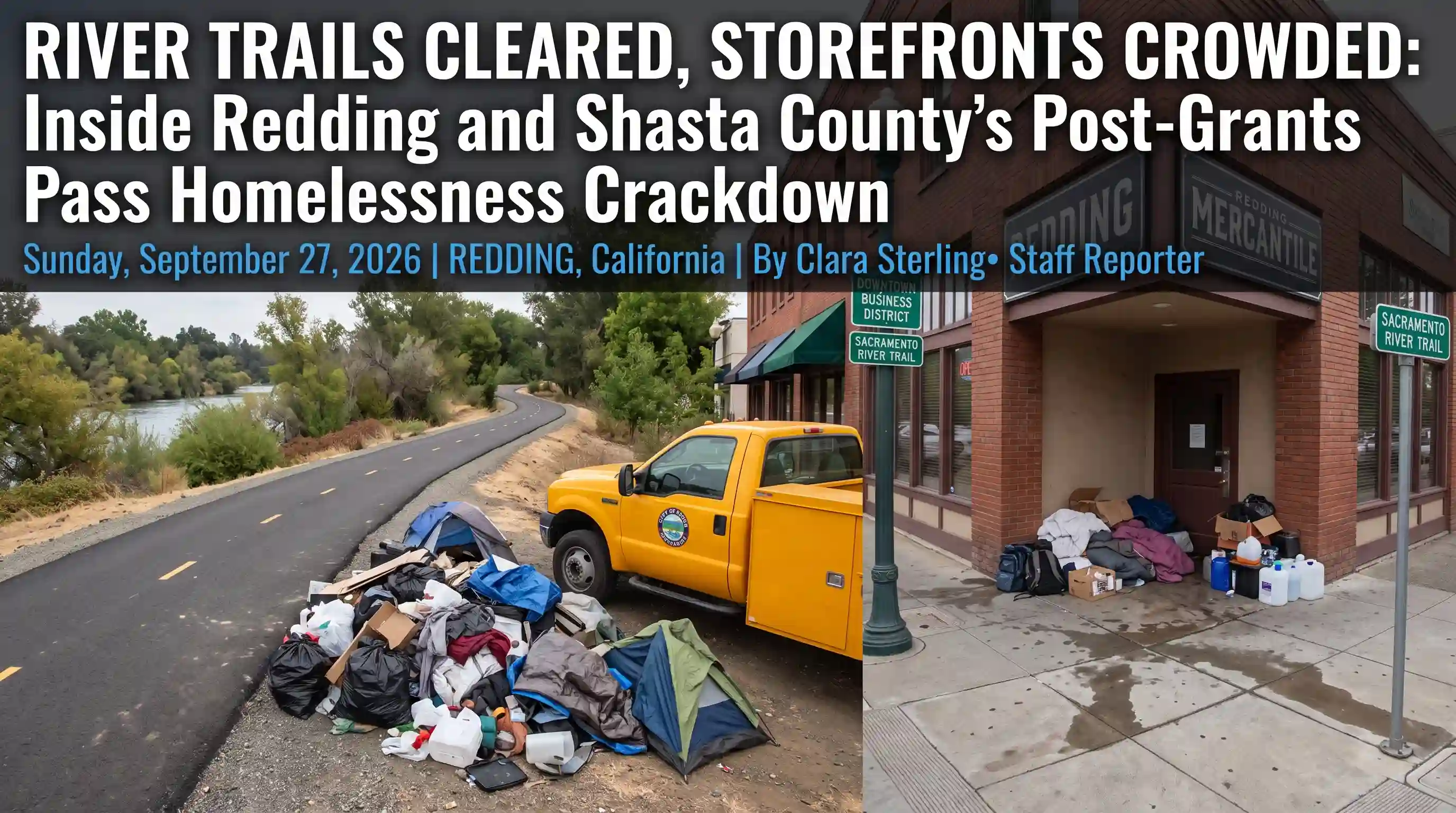
Municipal and county bans remove thousands of pounds of debris along the Sacramento River Trail, shifting street disorder into downtown storefronts amid limited regional shelter beds.
REDDING, California — Along the banks of the Sacramento River, heavy equipment and municipal remediation crews have extracted tens of thousands of pounds of debris, propane tanks, and biohazards from riparian encampments over recent months. Yet just blocks away in downtown Redding, commercial shopkeepers continue to wash human waste from their doorways each morning, illustrating a growing municipal dilemma: sweeping public spaces has reshuffled the geography of homelessness without reducing the population sleeping on the street.
Empowered by the U.S. Supreme Court’s landmark ruling in City of Grants Pass v. Johnson and California Executive Order N-1-24, the City of Redding and Shasta County have enacted aggressive ordinances banning camping on public property. The coordinated push has targeted environmental damage along the Sacramento River and mitigated wildland fire threats across urban greenbelts.
However, with emergency shelters operating near baseline capacity and divergent policies emerging between the city and county, the enforcement drive has highlighted severe bottlenecks in local housing and behavioral health infrastructure.
Clearing the Corridors: Fire Hazards and Riverbank Remediation
The operational push across Redding’s public lands has centered on two primary concerns: biohazard contamination in local waterways and wildland-urban interface fire risks.
Drainage basins feeding the Sacramento River—particularly around Hartnell Avenue, Bechelli Lane, the Masonic Avenue easements, and the riverbanks near Diestelhorst Bridge—have seen recurring multi-agency cleanups. Because these drainage channels flow directly into the Sacramento River, municipal crews must secure environmental permits from regional water quality control boards before deploying heavy equipment into riparian buffer zones.
Working with specialized contractors, city teams have removed between 2,400 pounds and upwards of 11,000 pounds of abandoned refuse, hypodermic needles, and biological waste during individual abatement operations.
Wildfire prevention provides a critical justification for these clearances. Municipal fire department records show that approximately 37% of all fires ignited within Redding city limits have been linked to unhoused activity, originating from unattended cooking fires, warming flames, or open burning in dense brush.
In response, the City of Redding established a joint task force pairing Redding Fire Department fire marshals with Redding Police Department (RPD) units. The team conducts safety audits across more than 50 established camps in designated high-fire-severity zones, seizing unpermitted cooking apparatuses, extinguishing open flames, and issuing immediate abatement orders.
To enforce park curfews and access rules on terrain standard patrol cruisers cannot reach, the city and county deploy specialized units. Community Services Park Rangers maintain daily patrols along the Sacramento River Trail, while RPD and the Shasta County Sheriff’s Office utilize Problem Oriented Policing (POP) teams equipped with utility terrain vehicles (UTVs) to navigate steep levees, drainage ditches, and railroad easements.
Street-level outreach before abatements is handled by RPD’s Crisis Intervention Response Team (CIRT), which pairs sworn officers with county behavioral health caseworkers to connect campers with services before crews clear the land.
The Policy Split: City Initiatives vs. County Enforcement
The regulatory landscape governing public sleeping shifted fundamentally after Grants Pass eliminated Eighth Amendment barriers established under Martin v. Boise. Unshackled from federal mandates requiring available shelter beds prior to enforcement, local governing bodies revised their penal codes.
In the City of Redding, enforcement centers on Municipal Code Chapter 10.40, as amended by Ordinance 2598. The code prohibits camping on all city-owned property—including parks, trails, easements, and utility substations—and bans vehicle habitation on public streets between 10:00 p.m. and 5:00 a.m.
Critically, Ordinance 2598 codifies a strict definition of "available shelter". While individuals cannot be cited if existing shelters are full or have expired stay limits, the ordinance establishes that if an individual is barred from a shelter due to voluntary behavior—such as intoxication, active drug use, rule violations, or disruptive conduct—a bed is legally considered "available," subjecting the person to immediate enforcement.
The City Council reinforced its position by voting to formally oppose California Senate Bill 634, arguing that proposed state limitations on sweeps would erode the authority restored by Grants Pass.
Unincorporated Shasta County has taken an even more punitive approach. On December 10, 2024, the Board of Supervisors adopted Ordinance 2024-13, expanding Sheriff's Office authority to remove informal camps and vehicles from county lands, drainage channels, and permanent road divisions without verifying shelter bed availability.
Concurrently, county supervisors have pursued ordinances restricting panhandling within 50 feet of intersections and commercial driveways.
This policy divergence has generated regional friction. While the City of Redding pairs enforcement with grant acquisition and transitional housing pilots, the county Board of Supervisors has prioritized jail expansion and alternative custody over municipal-style shelter infrastructure. Because unincorporated county lands strictly prohibit camping without providing emergency beds, unhoused residents are routinely displaced directly into Redding’s urban core, where charitable services and feeding programs are concentrated.
The Shelter Deficit and the Micro-Shelter Alternative
While public space enforcement has expanded rapidly, the regional emergency shelter network remains constrained.
Shasta County’s primary emergency congregate shelter is the Good News Rescue Mission (GNRM) in downtown Redding. While the Mission carries a total emergency surge capacity of 389 beds (and up to 420 in extreme weather contingencies), its baseline operational setup accommodates 256 individuals:
111 beds in the main men's shelter.
80 beds in the women and children’s wing (House of Hope).
40 beds in the men’s 18-month faith-based recovery program (The Bridge).
25 beds dedicated to women’s rehabilitation (Victory House).
Official point-in-time counts show regional shelter occupancy fluctuating between 63% and 75% on standard nights, suggesting an apparent surplus of open beds. In practice, however, entry-level beds are frequently full due to strict institutional criteria. The Mission enforces structured operating standards, including a 30-day stay limit followed by a mandatory 30-day out period, daily curfews, and behavioral rules. While non-disruptive individuals with substance use disorders are admitted, active intoxication or behavioral non-compliance leads to immediate exclusion, leaving those with high clinical acuity outside the shelter's doors.
To address the limitations of congregate facilities, local leaders have invested in non-congregate micro-shelter villages:
Veda Street Village: Located on a third of an acre on GNRM’s campus, the site features 17 individual micro-shelters (combining eight Pallet structures with nine prefabricated wooden units). Funded through a $100,000 Encampment Resolution Funding (ERF) grant from the city alongside $130,000 in donor matching, the community offers climate-controlled units and intensive case management for up to 10 months to stabilize individuals exiting street camps.
South Market Micro-Shelters: An eight-unit transitional community operated near the downtown transit center through a partnership between the City of Redding, the United Way of Northern California, and Pathways to Housing. The facility serves as an off-ramp for individuals displaced during large-scale clearances, such as the Nur Pon Henderson Open Space remediation.
Long-term behavioral health capacity is slated for expansion through GNRM’s planned Adult Rehabilitation Campus. The project secured $17.8 million through California’s Behavioral Health Continuum Infrastructure Program (BHCIP Round 1: Launch Ready), backed by Proposition 1 and $3 million in municipal and private matching funds. The campus will introduce a 75-bed adult residential substance use disorder treatment facility and an expanded Day Resource Center through 2027.
Yet these expansions stand in stark contrast to broader safety-net strains. Shasta County Health and Human Services (HHS) has operated under a multi-million-dollar deficit that required a $10 million emergency county loan and staff furloughs, while the Board of Supervisors previously rejected a proposed $150 million state-funded behavioral health hospital, cementing regional deficits in acute psychiatric care.
Frontline Fractures: Providers, Campers, and Downtown Merchants
The surge in enforcement has altered ground-level dynamics across the community, generating conflicting outcomes for social service workers, unhoused individuals, and downtown businesses.
Frontline housing navigators and street-medicine workers report that rapid camp abatements disrupt stabilization efforts. Building trust with unhoused residents experiencing severe psychiatric conditions or trauma requires months of regular contact. When camps are swept, that contact is broken, forcing caseworkers to spend weeks searching for displaced clients across new, informal sites, which stalls medical triage and permanent housing applications.
For unhoused individuals living along the riverbanks, enforcement has created a cycle of displacement and asset loss. Displaced residents report losing weather-rated tents, blankets, medication, and essential state identification during clearances. Replacing state-issued IDs presents a bureaucratic barrier without a stable mailing address or transit funds.
Furthermore, citations issued under Redding Municipal Code Chapter 10.40 carry fines of $455 or more. Unable to pay, indigent campers see these infractions convert into bench warrants, leaving them vulnerable to arrest and short-term booking before being released back to the street.
Meanwhile, downtown Redding merchants observe a direct spillover effect. While business owners praise the clearance of riverfront trails and park networks, they note that sweeping the waterways pushes campers directly into the downtown business district.
Storefront alcoves, commercial entryways, and pedestrian alleys frequently absorb individuals displaced from the river. Merchants describe dealing daily with human waste, discarded needles, open drug use, and erratic behavioral disturbances that discourage retail customers.
While the business community strongly supports enforcement under Ordinance 2598, retail owners argue that sweeps without expanded locked facilities or designated camping areas merely disperse street disorder from the riverbanks to commercial sidewalks.
The Road Ahead
Shasta County and the City of Redding have demonstrated the legal authority to dismantle entrenched encampments and clean up environmentally sensitive waterways. Yet with unsheltered numbers continuing to rise across the county, local leaders face an operational reality: public space enforcement alone does not end homelessness.
Bridging the divide will require resolving policy differences between Redding's grant-supported sheltering initiatives and the county's retributive justice strategies, stabilizing HHSA’s clinical outreach budget, and accelerating non-congregate housing pipelines like Veda Street Village and the Adult Rehabilitation Campus.
Until regional emergency beds and addiction treatment expand to match street-level demand, municipal abatements along the Sacramento River will continue to cycle individuals between rural riverbanks and downtown storefronts.