Political Cowardice on the Shasta Board: How Supervisors Torpedoed County Counsel Joe Larmour
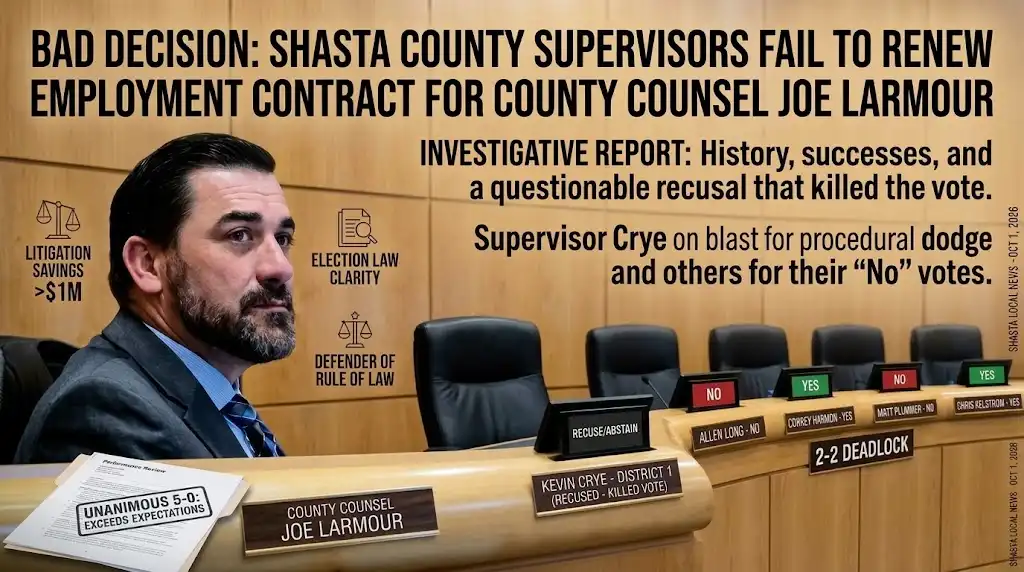
After unanimously rating County Counsel Joe Larmour "Exceeds Expectations" behind closed doors, a fractured Board of Supervisors killed his four-year contract extension—caving to fringe election denialists and personal political interests.
REDDING, California — When the Shasta County Board of Supervisors convened on Tuesday, September 29, 2026, county taxpayers witnessed an astonishing spectacle of governance in reverse. Just minutes after emerging from a closed session where all five supervisors unanimously gave Shasta County Counsel Joseph "Joe" Larmour an unblemished, top-tier performance rating of "Exceeds Expectations," the board torpedoed an employment agreement to retain him.
The proposed agreement—slotted as Item C-10 on the agenda—would have renewed Larmour’s four-year term through September 30, 2030, securing Shasta County’s top legal officer at an annualized base salary of $250,080. Instead, the vote deadlocked in a 2–2 tie, effectively killing the contract renewal.
Voting in favor were Board Chair Chris Kelstrom and Supervisor Corkey Harmon, both of whom recognized the legal expertise and stability Larmour brought to a county weary of perpetual turmoil. Voting against were Supervisors Allen Long and Matt Plummer.
The kill shot, however, came from outgoing District 1 Supervisor Kevin Crye. After spending twenty minutes shouting down the public, breaking closed-session confidentiality to boast about Larmour's perfect evaluation, and openly musing about poaching Larmour for his own private business venture in South Africa, Crye tucked his tail and recused himself when roll call was called. By refusing to cast the decisive "Yes" vote he had spent months promising, Crye manufactured an artificial 2–2 stalemate, hanging the county’s chief legal advocate out to dry.
Failing to lock down Joe Larmour's employment contract is one of the most short-sighted, politically reckless blunders this board has committed. In a county drowning in multi-million-dollar lawsuits, rogue election activism, and crushing budget constraints, sacrificing an exceptional legal tactician on the altar of personal grudges and political self-preservation will cost Shasta County dearly.
Proven Competence in a Sea of Chaos: Why Joe Larmour Was Indispensable
To understand why killing Larmour’s contract renewal is so damaging, look at the disaster that preceded him. Following the 2022 recall of Supervisor Leonard Moty and the ascension of an anti-establishment majority, Shasta County’s legal department turned into a revolving door.
Longtime County Counsel Rubin Cruse Jr. left for private practice with Renne Public Law Group in early 2023. Over the next eighteen months, Shasta County burned through five different chief legal officers. Executive turnover cost taxpayers over $740,000 in executive severance settlements alone, while outside private law firms collected hundreds of thousands in billable retainers to manage routine municipal business.
Larmour put an end to that hemorrhage.
A native of Redding and a graduate of the Cal Northern School of Law, Larmour brought more than fourteen years of specialized public-sector experience to the post. He spent five years as a senior associate at the municipal law firm Prentice, Long & Epperson, advising rural jurisdictions including Modoc, Alpine, Sierra, and Trinity counties. In 2020, he was recruited as Chief Deputy County Counsel in Yuba County at an advanced rate index, eventually rising to full Yuba County Counsel in 2023.
When Shasta County hired him in April 2024, Larmour immediately brought stability to a legal department on the brink of collapse.
The financial and operational results speak for themselves:
Over $1 Million in Litigation Savings: By moving specialized legal work, writ defenses, and administrative proceedings back in-house, Larmour slashed Shasta County's bloated reliance on outside private counsel, netting more than $1 million in operational savings, as confirmed on the record during Shasta County Board deliberations.
Exposing the Measure P Charter Defect: When the board majority passed Measure P in March 2024 under the illusion that it granted Shasta County home-rule autonomy from Sacramento, it was Larmour who audited the text and caught the fatal drafting defects. He bluntly informed the board that the measure failed to establish a constitutionally compliant charter under Article XI of the California Constitution, preventing costly administrative missteps before the state stepped in.
Defending the Rule of Law on Measure B: When local activists qualified Measure B—an unconstitutional local ballot initiative mandating full manual hand-counting, mandatory voter photo ID, and air-gapped computers—Larmour took the legally sound stance. Knowing the measure directly violated California Assembly Bill 969 and Senate Bill 1174, Larmour filed a declaratory relief action (County of Shasta v. Laura Hobbs, et al.) to protect the county from crippling statutory attorney fee awards. When the California Attorney General and Secretary of State intervened in People ex rel. Bonta & Weber v. County of Shasta, Larmour represented county interests with legal integrity rather than ideological theater.
Holding the Line on Ballot Retention: In late September 2026, when populist activists demanded that the county indefinitely preserve November 2024 paper ballots to hunt for conspiracy theories, Larmour enforced federal law (52 U.S.C. § 20701) and California Elections Code § 17301, which dictate strict 22-month retention schedules. When rogue Registrar of Voters Clint Curtis padlocked Room 206 and halted shredding contractors at the 11th hour, Larmour formally cautioned Curtis that his unilateral obstruction exposed the county to serious statutory liabilities.
Joe Larmour did what a county counsel is sworn to do: give objective, unvarnished legal counsel to keep Shasta County out of civil exposure and administrative chaos. For that, the board’s political factions decided he had to pay.
Kevin Crye Put on Blast: The Grandstanding Coward Who Killed His Own Guy
There is no sugarcoating Supervisor Kevin Crye’s behavior at the September 29 meeting: it was a masterclass in political cowardice.
From the day Larmour arrived in Redding, Crye bragged publicly that he personally "poached" Larmour from Yuba County. Crye championed Larmour on conservative podcasts, in radio appearances, and from the dais, claiming Larmour was the only attorney in Northern California with the spine to push back against Sacramento overreach.
Yet when Larmour needed Crye to deliver a single vote, Crye ran away.
During the meeting, Crye went to dramatic lengths to portray himself as Larmour’s savior:
Compelling the Confidentiality Waiver: Crye forced a 5–0 roll call vote to waive closed-session confidentiality under the Brown Act, solely so he could grandstand before the cameras and broadcast that the board had rated Larmour "Exceeds Expectations."
Attacking the Critics: He scolded public commenters, telling the audience that an attorney of Larmour’s caliber would command double the salary in the private sector and that the board needed to "lock him down."
The South Africa Boast: Crye openly declared on the dais that if his own commercial organizations or his international business venture in South Africa ever needed legal counsel, he would poach Larmour from the county in a heartbeat, as documented on Crye’s dais recap video.
Then came the roll call on Item C-10.
Instead of voting "Yes," Crye muttered: "I'm going to recuse because I won't be here."
That wasn't a recusal; it was a cowardly surrender. Under California law, elected supervisors have an affirmative legal duty to vote on matters properly brought before them. A recusal is only legally permissible when founded upon a formal financial conflict under California Government Code § 1090 or the Political Reform Act (Gov. Code § 87100). Being a "lame duck" who lost a reelection bid to Erin Resner in the June primary is not a legal conflict of interest. Crye maintains full fiduciary and legal responsibility until his term officially ends in January 2027.
Crye knew the math. Supervisors Long and Plummer had already pulled the item from consent and signaled their opposition. On a five-member board with two confirmed "No" votes, a recusal is mathematically identical to a "No" vote. Crye knew that by withholding his vote, the motion would stall 2–2 and fail.
Why did Crye do it? Because he wanted to have it both ways. Facing furious blowback from local election denial activists who hate Larmour for enforcing state election laws, Crye was terrified of the political fallout of voting to approve an 18-month severance protection package on his way out the door. At the same time, he wanted to play the noble warrior defending his handpicked ally.
Crye prioritized his own political vanity over Shasta County’s legal stability. He talked like a lion and voted like an empty chair.
Supervisors Allen Long and Matt Plummer Put on Blast: Hypocrisy and Commercial Conflicts
Supervisor Kevin Crye’s cowardice was matched by the staggering hypocrisy and questionable motives of Supervisors Allen Long and Matt Plummer.
How does an elected official look the public in the eye, vote behind closed doors that County Counsel Joe Larmour "Exceeds Expectations" in his performance evaluation, and then immediately march out onto the dais and vote to kill his contract renewal?
The justifications offered by Long and Plummer collapse under the slightest scrutiny.
Allen Long’s Glaring Conflict: Spousal Retainers vs. In-House Counsel
Supervisor Allen Long attempted to wrap his "No" vote in high-minded procedural rhetoric, citing California Government Code § 27641 and claiming that a four-year contract should run down so the incoming board can "build their team."
That pious performance fell apart during Crye’s open-session confrontation on the dais. Crye directly addressed the elephant in the room: "Supervisor Long says it’s not personal. Well, he worked for your wife and quit."
The reality behind that accusation deserves the harshest public spotlight:
Supervisor Allen Long is married to Margaret E. Long, the founding member and managing partner of Prentice | Long, PC, a private municipal law firm headquartered in Redding.
As detailed on the Prentice | Long Firm Attorney Directory, the firm specializes in contracting with rural California counties to act as external County Counsel and handle special litigation retainers.
Larmour worked for Margaret Long's firm as a Senior Associate from 2015 to 2020 before leaving to join Yuba County.
Former Shasta County interim legal staff, such as Gretchen Stuhr, also moved between county desks and partner suites at Prentice | Long, PC.
Under California community property laws, Supervisor Long has a direct economic interest in his wife’s private law firm. And how does a private municipal firm profit? By securing lucrative, high-priced contract counsel retainers from local governments that lack stable in-house legal departments.
During the 18 months before Larmour took over—when Shasta County had five chief legal officers in a single year—external law firms racked up millions in billable hours. Larmour built an in-house operation that cut outside legal retainers by over $1 million.
For Supervisor Long to vote against renewing the employment contract of a proven in-house counsel who left his wife's firm—while that very firm stands to benefit whenever the county legal chair sits vacant—reeks of personal animus and a glaring institutional conflict of interest. Long's claim that his vote had "nothing to do with County Counsel personally" is an insult to the intelligence of Shasta County voters.
Matt Plummer’s Hollow Excuses: Abstract Governance Over Practical Success
Supervisor Matt Plummer took a different, though equally disingenuous, approach.
On the dais and in a subsequent video statement on the County Counsel renewal vote, Plummer openly admitted that Larmour had "done a good job" navigating immense political turmoil. Yet Plummer voted "No" anyway, hiding behind two procedural objections:
The "Year Three" Doctrine: Plummer claimed that four-year executive contracts should never be reset annually and should instead only be renegotiated near the end of their third year.
The 18-Month Severance Clause: Plummer objected to the contract's mutual separation severance provision, which capped liquidated damages at 18 months of base salary (~$375,000) if Larmour were let go without cause, calling it excessive.
Plummer’s procedural posturing is completely detached from reality.
Shasta County is not a routine, sleepy municipality operating under normal administrative conditions. It is one of the most litigious, politically volatile local governments in the United States. Top-tier public agency attorneys know that working for Shasta County means putting their professional licenses, personal reputations, and mental health on the line every single Tuesday.
As Larmour clarified during the meeting, the 18-month severance clause only applied to an agreed-upon, mutual separation—not if he were removed for cause under California Government Code § 27641. You cannot recruit or retain elite legal talent in a hostile political circus without offering contractual security. Plummer’s ideological insistence on an invented "year three rule" ignores that by 2027, Larmour could walk out the door for any number of private-sector offers, leaving Shasta County right back in the chaotic vacuum of 2023.
Plummer gave an "Exceeds Expectations" employee a pink slip on his future, choosing bureaucratic rigidity over institutional protection.
Capitulating to the Fringe: What the Board's Failure Really Means
The September 29 vote did not occur in a vacuum. It unfolded before an audience dominated by radicalized local activists demanding Larmour’s head.
For months, populist organizers like Laura Hobbs, Linda Glass, and Kim Moore have waged a relentless smear campaign against Larmour. They attacked him because he refused to legitimize their false claims about the 2024 election. They attacked him because he told the Shasta County Election Commission that their extra-legal resolutions belonged "in the burn barrel." They attacked him because he adhered to state and federal ballot destruction mandates instead of yielding to conspiracy theories about fake ballots with blue headings.
The boardroom also heard weaponized references to Alan B. Cox v. County of Shasta, an active whistleblower lawsuit filed in Shasta County Superior Court by a former deputy counsel. Rather than allowing the judicial system to adjudicate disputed personnel claims, vocal activists seized upon the filing to frame Larmour as corrupt.
By failing to renew Larmour's contract, the Board of Supervisors rewarded this lawless pressure campaign.
They sent a chilling message to every public servant, department head, and attorney working in Shasta County: If you uphold the law, enforce the California Constitution, and protect county taxpayers from illegal liability, this board will abandon you the moment political pressure mounts.
The Reckoning Ahead for Shasta County
Because the motion on Item C-10 failed on a 2–2 tie, Joe Larmour will continue serving under his August 2025 contract, which keeps him in office into mid-2029. But the damage has been done.
By refusing to extend his employment contract through 2030, this board signaled to the incoming 2027 board—which will seat Supervisor-elect Erin Resner in District 1—that Larmour is politically vulnerable. The board stripped its own legal department of leverage and signaled to the state, external litigators, and fringe activists that Shasta County's executive leadership remains divided and weak.
Supervisor Kevin Crye ran away from his responsibilities. Supervisor Allen Long protected a competing web of legal and family interests. Supervisor Matt Plummer hid behind procedural purism.
Together, they punished a County Counsel who brought stability, cut external legal costs by $1 million, and defended the rule of law against overwhelming populist hostility. If Joe Larmour ultimately takes Kevin Crye up on his offer and departs for greener, saner pastures, Shasta County taxpayers will be left holding the bill for another disastrous cycle of high-priced turnover, catastrophic legal blunders, and unchecked political dysfunction.