Behind the Lawsuits and Livestreams: The Heavy Cost of Arne List’s Shasta County Crusade
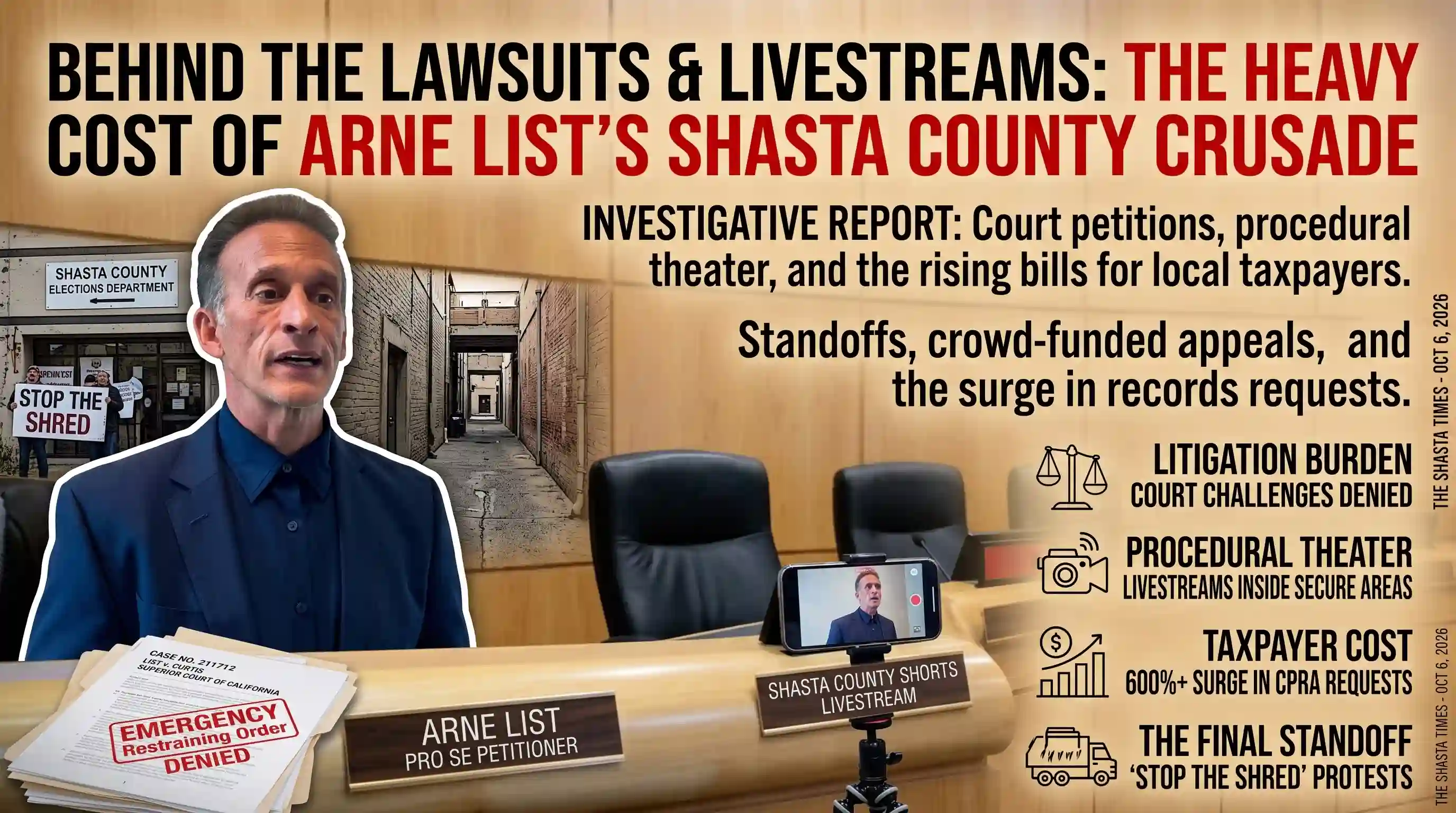
From Venice Beach bodybuilding and Beverly Hills commercial finance to emergency ballot petitions and Shasta County livestreaming: an investigative examination of Arne List’s campaign and its escalating toll on county taxpayers.
REDDING, California — When mobile commercial shredding trucks arrived behind the Shasta County Elections Department on Market Street in late September, their presence was intended to mark a routine legal procedure: the statutory disposal of ballots from the November 5, 2024, general election.
Instead, the loading dock became the site of a multi-week municipal standoff. Over a dozen demonstrators waving "An Appeal to Heaven" flags lined the alleyway, county officials traded public accusations of insubordination, and county legal counsel prepared to defend against an emergency lawsuit in Shasta County Superior Court.
At the center of this controversy is Arne Edward List, a 6-foot-plus former Southern California competitive bodybuilder and commercial finance broker who relocated to Northern California and quickly embedded himself in Shasta County’s civic affairs.
Over the past two months, List has transitioned from producing mobile livestreams inside secure election offices to lodging civil petitions against county leadership, confronting county supervisors from the dais, and soliciting thousands of dollars online for emergency legal appeals.
While List and his supporters frame his interventions as a principled defense of public transparency, an examination of court records, public disclosures, and county agendas paints a different picture: a campaign built on misread statutes and procedural theater that has left local taxpayers footing the bill for ballooning legal fees and administrative gridlock.
The Anatomy of List v. Curtis
List entered the county legal record on September 9, 2026, when he filed a pro se civil action in Shasta County Superior Court: List v. Clint Curtis.
List styled his filing as a "narrow emergency preservation proceeding." The petition asked the court to block Shasta County from executing the scheduled disposal of November 2024 general election ballots. In the filing, List disclaimed any desire to open, inspect, recount, or seize the ballots. Instead, he argued that the physical cartons must remain locked in the county vault in case a recent federal grand jury subpoena concerning the June 2026 primary required comparative forensic review.
However, the legal basis of the petition collapsed under judicial review.
Under both federal statute (52 U.S.C. § 20701) and state law (California Elections Code Section 17301), county election officials are required to retain federal general election materials unopened and unaltered for exactly 22 months from the date of the election. For the November 5, 2024, election, that statutory retention window expired on September 5, 2026.
Once that 22-month window closes, Section 17301(c) provides that unless an official election contest was filed within the statutory window under Division 16, or an active criminal indictment was initiated, the elections official "shall have the items... destroyed or recycled."
In arguments before the public and in court filings, List argued that election records must be kept for five years, asserting that disposal constituted unlawful destruction of evidence. But state law makes a clear distinction: while California Elections Code Section 17300 provides a five-year retention standard for voter registration rosters, voted paper ballots are governed exclusively by Section 17301's strict 22-month cap.
On September 15 and 17, Shasta County Superior Court Judge Benjamin L. Hanna denied List’s applications for emergency temporary restraining orders. The court noted that List lacked legal standing to unilaterally halt mandatory county operations, pointing out that the petition failed to present verified declarations or admissible evidence of fraud.
A Friendly Lawsuit
While public dockets named Shasta County Clerk and Registrar of Voters Clint Curtis as the primary respondent, our investigative reporting revealed that the lawsuit was far from adversarial.
Just 24 hours before filing the action, List texted Curtis directly to coordinate the strategy. According to court records and regional reporting, Curtis informed List on September 8 that the shredding was scheduled for September 11. When List asked if Curtis would support a court petition to block the disposal, Curtis texted back:
"Sure. I would prefer them somewhere else but can leave them locked up at the office."
Curtis, who was ousted by local voters in the June 2026 primary by Joanna Francescut and subsequently censured 3–1 by the Board of Supervisors on August 11 for workplace misconduct, appeared to view List's outside legal filing as a convenient vehicle to resist the Board of Supervisors and County Counsel.
List himself acknowledged the coordinated nature of the filing on his online campaign page:
"THIS IS NOT PERSONAL. My lawsuit names Clint Curtis in his official capacity as Shasta County Registrar of Voters. This is not a personal attack. I spent time inside his Elections Office and have publicly acknowledged the transparency I personally witnessed."
Who Is Arne List?
Public curiosity regarding List has focused heavily on his rapid appearance in North State politics. A closer look into public records reveals a multi-decade career that began far outside municipal government.
Between 1988 and 2000, List was a fixture in the national competitive bodybuilding circuit, training out of Gold's Gym Venice on Hampton Drive during the sport’s modern boom. Athletic archives from USAMuscle and competitive records show List achieved major athletic milestones, winning first place in the Men's Heavyweight class at the 1996 IFBB North American Championships and representing the United States at the 1994 IFBB World Mixed Pairs Championships in Borlänge, Sweden.
Arne Edward List: Key Milestones
├── 1988–2000: Competitive Heavyweight Bodybuilding (Gold's Gym Venice)
│   ├── 1994: IFBB World Mixed Pairs Finalist (Sweden)
│   ├── 1996: Class Champion, IFBB North American Championships
│   └── 2000: NPC National Championships Finalist
├── 2000s–2010s: Commercial Real Estate Finance & Mortgage Brokerage
│   ├── Broker of Record & CFO, Genx Capital Corporation (Studio City, CA)
│   └── Creditor/Party in In re Lehman Brothers Holdings Inc. bankruptcy dockets
├── 2019: Civil Rights Estate Representation
│   └── Public spokesperson for the late James Hart Stern (Moreno Valley, CA)
├── 2020: Southern California Exit
│   └── Sells Studio City residence for $3,095,000 (Dec. 2020)
└── 2026: Shasta County Public Advocacy & Litigation
    ├── Launches "Shasta County Shorts" digital video series
    ├── Files List v. Curtis (Case No. 211712) in Shasta County Superior Court
    └── Stages "Stop the Shred" demonstrations outside Elections Department
Following his athletic career, List shifted into commercial mortgage financing. California corporate filings show he served as Broker of Record and Chief Financial Officer of Genx Capital Corporation on Ventura Boulevard in Studio City. His corporate operations surfaced in federal bankruptcy records, where Genx Capital was noticed as an interested party in the Lehman Brothers Holdings Inc. bankruptcy liquidation proceedings.
In 2019, List surfaced in Riverside County as the personal representative and media liaison for civil rights activist James Hart Stern. Stern had gained national attention by legally taking over the corporate charter of the National Socialist Movement to dismantle the neo-Nazi group from within. When Stern passed away from cancer in October 2019, List coordinated memorial arrangements and served as the estate's spokesperson with national media outlets.
Property records indicate List concluded his residential footprint in Los Angeles County in December 2020, selling his luxury home on Dona Pegita Drive in Studio City for $3,095,000. By 2026, he had relocated his attention north, speaking during public comment periods at Shasta County Board of Supervisors meetings regarding federal Opportunity Zones and signaling interest in working inside the local elections office.
The Camera in the Vault: "Shasta County Shorts"
List’s public profile in Redding accelerated through his self-produced Facebook video series, Shasta County Shorts.
In late August 2026, Curtis granted List access behind the secure keycard barriers of the Market Street elections facility. On August 23, List published Episode 20, titled "The Walkthrough." The video captured Curtis giving List a guided tour of intake processing stations, tabulation machines, and secure ballot storage vaults, narrating operational procedures directly into List's handheld camera.
The video bypass occurred despite Curtis already being under intense administrative scrutiny. Local civic outlets had spent months detailing operational irregularities inside the department, including released internal security camera footage from late 2025 showing Curtis moving election safes after hours.
By early September, List used the credibility gained from his recorded walkthroughs to pivot from digital interviewer to courtroom petitioner, presenting himself as a self-appointed auditor of Shasta County's records.
The Dais Confrontation
List's campaign reached a boiling point on September 29, 2026, during the regular meeting of the Shasta County Board of Supervisors.
Approaching the podium during general public comment, List bypassed customary pleasantries and directly targeted Board Chair Chris Kelstrom and Supervisor Corkey Harmon. In remarks broadcast and recorded in the county's video archive, List accused the supervisors of personal betrayal:
"The first rule in covering up crime is destroy the evidence. I asked you both, do you want [the Department of Justice to investigate]... You both said yes. Now you're saying no."
List claimed that because California penal statutes carry multi-year statutes of limitations for felony fraud, shredding physical ballots at the 22-month mark constituted criminal spoliation of evidence.
Under the Ralph M. Brown Act (California Government Code Section 54954.2), supervisors are legally prohibited from debating non-agendized matters raised during open public comment. Kelstrom maintained board decorum and called the next speaker without responding to List's allegations of private meetings in their homes.
Behind closed doors, however, county leadership treated the matter with legal seriousness. On September 15, the Board held an executive closed-session conference with County Counsel Joseph Larmour regarding List v. Curtis. Larmour advised the Board that failing to execute ballot disposal once the 22-month window closed exposed Shasta County to statutory enforcement actions and civil liability from state regulators.
The Cost to Local Taxpayers
While List promoted his campaign across regional talk shows—including Paul Preston’s Agenda 21 Radio on the American Exceptionalism News Network and alignments with New California State Shasta—the administrative fallout landed directly on Shasta County taxpayers.
Over the past three years, Shasta County has been hit with an unprecedented surge in California Public Records Act (CPRA) requests:
| Calendar Year | Total Countywide CPRA Requests | Video Footage Requests | Documented Administrative Impact |
|---|---|---|---|
| 2024 | 213 total | Baseline records processing | Handled within existing departmental staff capacity |
| 2025 | 932 total | Significant increase | Ballot processing backlogs; staff reassignment |
| 2026 (thru Sept.) | 1,507 total | 554 requests | "Thousands of hours" of redaction; outside vendor needed |
According to Board staff reports submitted on September 15, the county logged 1,507 public records requests in the first nine months of 2026 alone—a more than 600% increase over 2024 levels. Over 500 of those requests demanded video surveillance footage, including a single request demanding every second of security camera video across two continuous months of ballot handling inside the Elections Department.
Because California open records law requires county personnel to review and redact sensitive facility layouts, keypads, and personal voter information frame by frame, County Counsel was forced to seek emergency authorization to hire specialized outside contractors to avoid state compliance fines.
The litigation burden has also compounded municipal legal costs. Recent investigations by the Shasta County Civil Grand Jury, titled Cost of Outside Legal Counsel for Shasta County, revealed that county contract legal spending had climbed by more than 70% over four years.
To manage its legal liabilities, the county maintains an annual baseline budget of $700,000 for outside counsel. On the exact same September 15 agenda where supervisors met in closed session to address List’s lawsuit, the Board approved a $150,000 contract renewal with outside investigations firm Van Dermyden Makus at billing rates reaching $525 per hour.
Shasta County Civic Dispute Dynamics
┌───────────────────────────────┐      ┌───────────────────────────────┐
│     The Activist Playbook     │      │     The County Reality        │
├───────────────────────────────┤      ├───────────────────────────────┤
│ • Social media walkthroughs   │ ───► │ • Unprecedented CPRA backlogs │
│ • Low-cost pro se petitions   │ ───► │ • Emergency closed sessions   │
│ • "Destruction of evidence"   │ ───► │ • Outside counsel retainers   │
│ • GiveSendGo crowdfunding     │ ───► │ • Heightened security costs   │
└───────────────────────────────┘      └───────────────────────────────┘
The Fundraising Disconnect
Following Judge Hanna’s denial of his temporary restraining order, List announced he had retained constitutional attorney Alexander H. Haberbush of the Long Beach-based Lex Rex Institute—the same firm that represents the local proponents behind Shasta County’s Measure B initiative.
List launched an emergency campaign on GiveSendGo titled "Save Shasta County's 2024 Election Materials," seeking $25,000 to file emergency writs of supersedeas in the California Third District Court of Appeal. List noted that an immediate $10,000 cash deposit was required before legal counsel would begin drafting appellate briefs.
Despite intensive circulation across alternative digital platforms, the campaign stalled. By early October, the fundraiser had gathered just $2,475 from eight individual donors—leaving a $7,525 deficit that halted the contemplated appeal.
Searches of California Fair Political Practices Commission (FPPC) filings and the Shasta County NetFile Campaign Finance Portal confirm that List received zero contributions or disbursements from local political action committees, candidate committees, or formal political groups. The $500 court filing fee came out of List's own pocket, illustrating the structural gap between social media virality and the capital required to sustain complex constitutional litigation.
The Final Standoff
The dispute reached its final chapter on Saturday, October 3, 2026.
Days earlier, on September 30, shredding contractors had been turned away when election workers discovered that uncopied administrative tally logs—the subject of an active Public Records Act request filed by citizen monitor Kari Chilson—had been commingled with 2024 ballots by prior staff. County administration immediately issued a formal statement disavowing Curtis's refusal to proceed, warning that failing to follow state disposal mandates was unlawful.
Once the administrative logs were separated under state guidance, county personnel returned to the facility on Saturday morning to carry out the disposal.
Outside in the rear corridor, List and a small group of demonstrators picketed the loading bay, warning of racketeering claims. But with no active court injunction, no pending election contest, and no federal impound order, the shredding proceeded as required by state law. At 11:48 a.m., Shasta County completed the shredding of all eligible November 5, 2024, general election materials.
Two days later, on October 5, List stood before a dozen supporters outside the Board Chambers at 1450 Court Street, asserting that county officials had committed a crime.
Yet in the courtroom where evidentiary standards apply, no violations were found. Instead, the intervention left behind a familiar pattern: an outside activist utilizing local administrative fault lines to generate content, a court docket dismissed for lack of legal standing, and Shasta County taxpayers left to pay the bill for defending routine statutory duties.